Same Brand, Two Missions: Spider Chalk Black Widow vs White Widow
Quick Verdict: Black Widow is the everyday training chalk — compact, proven with 588 reviews, and versatile across sports. White Widow is the competition specialist — longer grip, thicker formula, and USAW/USAPL federation approval for meet day. Most athletes should start with Black Widow and add White Widow when competition demands it.
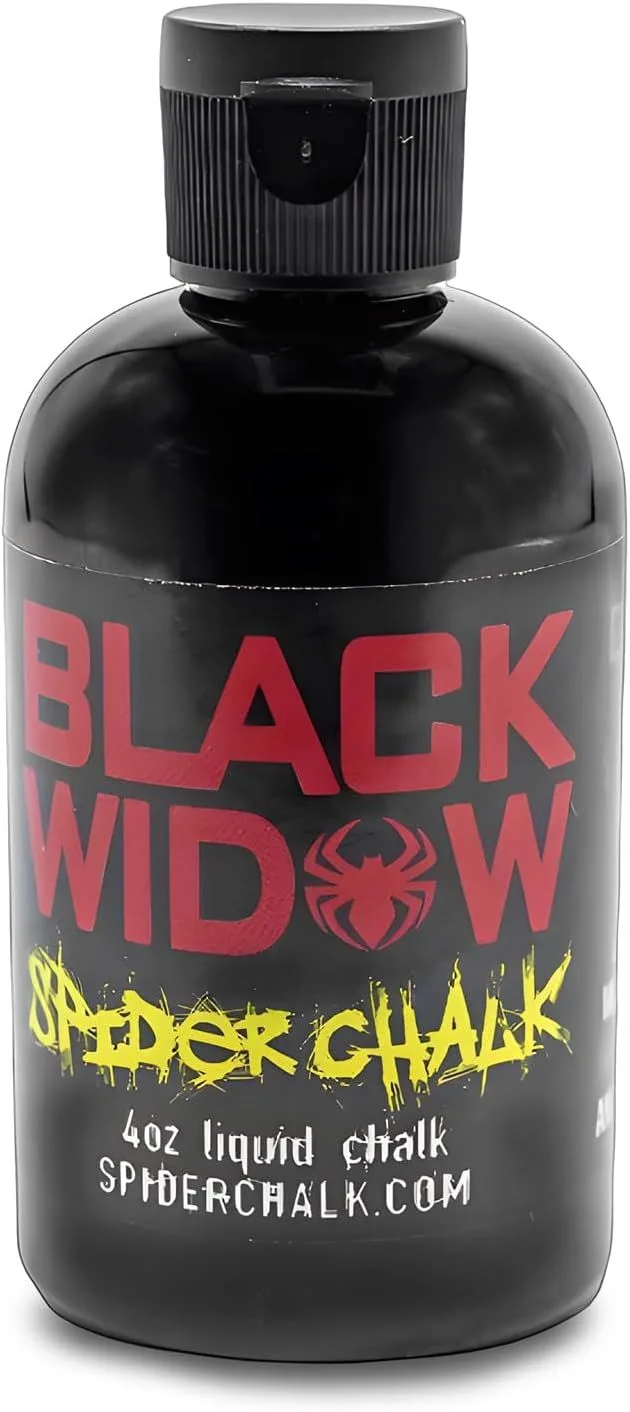
Spider Chalk Black Widow
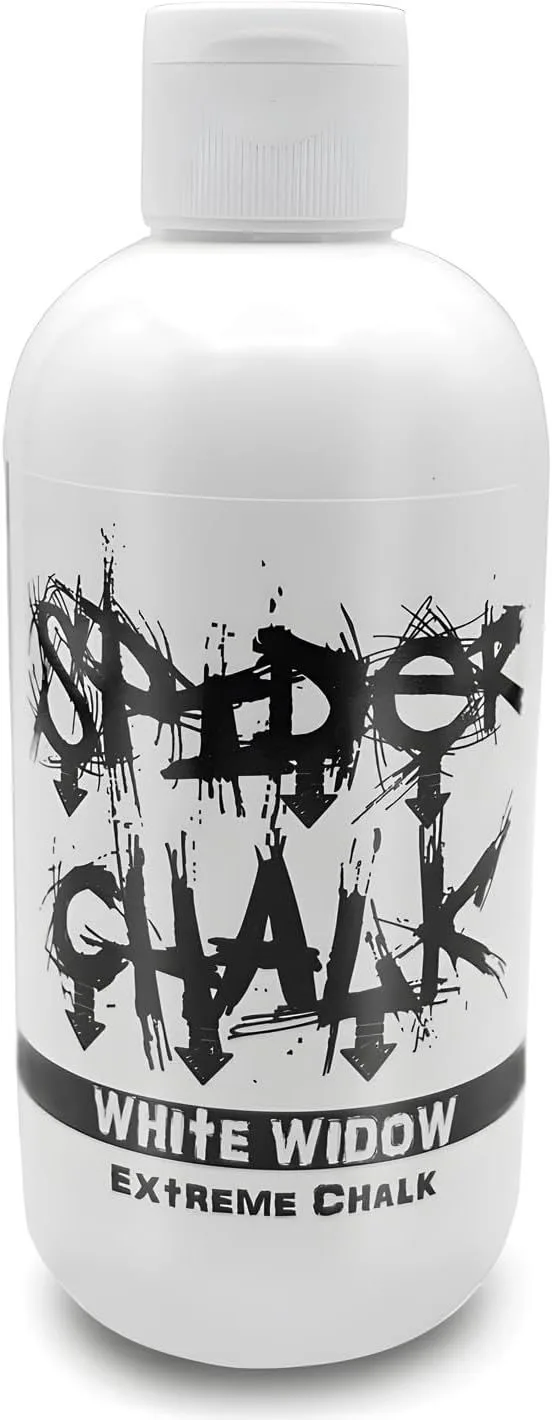
Spider Chalk White Widow
Specs at a Glance
| Feature | Spider Chalk Black Widow | Spider Chalk White Widow |
|---|---|---|
| Price Range | $15–$20 | $20–$25 |
| Volume | 4 oz (118ml) | 8 oz (237ml) |
| Dry Time | 15–20 seconds | 25–30 seconds |
| Grip Duration | 40–55 minutes | Up to 60 minutes |
| Key Ingredients | Magnesium carbonate, Grip-Lock nano-resins | Magnesium carbonate, nano-resins, tackifiers |
| Scent | Minimal | Minimal |
| Made In | USA | USA |
| Check Price | Check Price |
These two bottles share a brand name and a core philosophy — Grip-Lock Technology built in the USA. But they sit in different size categories, target different training scenarios, and contain different ingredient blends. Black Widow lives in your gym bag. White Widow lives on the competition platform or next to your home gym rack.
The Formula Split: How Nano-Resins Change the Grip
Black Widow uses Spider Chalk's original Grip-Lock formula — magnesium carbonate enhanced with proprietary nano-resins in a standard consistency. It dries in 15–20 seconds and provides 40–55 minutes of grip. That range is well above the average travel chalk, which typically delivers 20–30 minutes before you need to reapply. For a 4 oz bottle, that grip duration is a real differentiator against competitors like EVMT Brands and Medi Chalk.
White Widow takes the same Grip-Lock foundation and amplifies it. Additional nano-resins and tackifiers create an extra-thick paste that takes 25–30 seconds to dry — noticeably slower than Black Widow — but holds grip for up to 60 minutes. That extra 5–15 minutes sounds marginal in isolation. In practice, the difference shows up most during long, heavy sessions: a 90-minute powerlifting workout where you hit squats, bench, and deadlifts without wanting to stop and rechalke between movements.
The tackifiers in White Widow produce a slightly sticky feel on the hands after the formula dries. Some athletes love this — it creates an almost adhesive quality on a barbell knurl that feels like the bar is glued to your palms. Others find it distracting, especially climbers who prefer the clean, dry finish of standard magnesium carbonate. Black Widow dries to a more traditional chalk-like surface: dry, powdery, and friction-forward without the tack.
That tactile difference is personal preference, but it is a real difference you will notice in the first application. If you have only used basic liquid chalk before, White Widow's sticky finish will feel unfamiliar. Black Widow will feel closer to what you already know, just longer-lasting.
Bottle Size and Daily Portability
Black Widow ships in a 4 oz (118ml) bottle. That is compact enough for gym bags and climbing packs, but larger than the 50ml travel bottles from EVMT, Medi Chalk, HR8, and Catalyst Nutrition. It occupies a useful middle ground: small enough to carry every day without thinking about it, large enough that you are not reordering every two weeks of consistent training.
A 4 oz bottle fits in the side pocket of most gym bags, clips to the outside of a climbing pack, or slides into a cargo pocket if you train outdoors. It is not quite "toss it in your shorts pocket" small like a 50ml bottle, but it is far more portable than any 8 oz bottle on the market.
White Widow comes in a full 8 oz (237ml) bottle — a home gym or locker-room bottle, not something you toss in a day pack for a climbing trip. The upside is longevity. Spider Chalk claims 400+ applications per bottle, which translates to months of daily training from a single purchase. For athletes who train in one location — a home gym, a regular commercial gym where they keep a locker, or a climbing gym they visit three times a week — the larger format eliminates the annoyance of frequent reordering.
The portability question comes down to your training pattern. If you rotate between locations — gym in the morning, climbing wall in the evening, outdoor crag on weekends — Black Widow travels with you. If you train in the same spot every day and just want a bottle that does not run out, White Widow's 8 oz format is the practical choice.
How Grip Duration Actually Differs in Training
On paper, the difference between Black Widow's 40–55 minutes and White Widow's claimed 60 minutes looks small — 5 to 20 minutes depending on where each product falls within its range. In real training, the gap is more about the grip curve than the absolute duration.
Black Widow's grip starts strong — the first 20 minutes feel excellent, with a dry, firm hold on any surface. From minutes 20 to 40, the grip remains functional but begins to thin. By 45 minutes, most athletes can feel the chalk wearing away, especially on palms that sweat heavily. A mid-session reapplication at the 35–40 minute mark brings it back to full strength.
White Widow maintains a more even grip throughout its duration. The tackifiers act as a secondary layer — as the top magnesium carbonate layer breaks down from sweat and friction, the sticky resin layer underneath continues to provide friction. The result is less of a gradual fade and more of a consistent hold that drops off more sharply once the formula finally gives out around the 55–60 minute mark.
For a typical 60-minute training session with 15–20 working sets, Black Widow may need one mid-session reapplication. White Widow typically carries through without any. For a 90-minute session, both need reapplication — neither is truly "apply once and forget." But White Widow gives you one fewer interruption in a standard-length workout, and that is what competition athletes care about.
The real separation shows during maximal efforts. Under a 1RM deadlift pull, a heavy clean-and-jerk attempt, or a competition bench press, the grip demands spike far above anything that happens during warm-up sets. White Widow's tackifiers provide a noticeable advantage at these peak moments — the bar feels locked in place rather than just dry. For moderate-intensity training, the difference between the two products is negligible.
Competition Clearance: Where White Widow Separates
White Widow carries USAW (USA Weightlifting) and USAPL (USA Powerlifting) sanctioning. That means it is on the approved substances list for official competitions governed by those federations. If a meet director asks what chalk you are using, you can point to written approval.
Black Widow does not carry the same documentation. It uses the same core Grip-Lock Technology, and there is no indication that its formula would fail a substance check — but it does not have the written clearance that White Widow has. For recreational lifters, this distinction is irrelevant. But for competitive athletes who train specifically for sanctioned events, knowing your chalk is pre-approved removes one variable from an already stressful meet day.
The federation approval applies specifically to USAW and USAPL events. Other federations — IPF, IWF, USPA, CPU — have their own substance policies and approved product lists. If you compete outside USAW or USAPL, check your specific federation's rules before assuming White Widow's approval transfers. It is a strong signal of formula safety and compliance, but federation-specific clearance varies.
For climbing competitions, liquid chalk itself is generally the preferred format (many climbing gyms require it over powder). Neither Spider Chalk product has climbing-federation-specific approvals, but liquid chalk as a category is widely accepted at USAC and IFSC events.
Community Validation: 588 Reviews vs 90
Black Widow has accumulated 588 reviews at 4.5 stars. White Widow has 90 reviews at 4.5 stars — the same rating, but with a much smaller dataset. Both ratings are stable enough to be meaningful at their respective levels. Black Widow's 6.5x larger review pool gives it a clear statistical edge in terms of data reliability.
The review disparity makes sense. Black Widow has been on the market longer as Spider Chalk's original product — it launched first, built the brand's reputation, and accumulated reviews over a longer period. White Widow is the newer competition-focused variant that arrived after the brand had already established itself. As White Widow accumulates more reviews over the next year, the data gap will narrow.
Both products show the same complaint pattern in negative reviews: the thick formula can clog the bottle opening if not sealed properly between uses. This is a Spider Chalk characteristic, not a product-specific defect — the Grip-Lock formula is thicker than standard liquid chalks by design. Athletes switching from thin, alcohol-forward products like EVMT or Medi Chalk will notice the consistency difference immediately and may need to adjust their application technique (squeeze rather than pour, wipe the nozzle clean after use).
Positive reviews for both products consistently highlight the same theme: grip duration that outlasts competitors by a wide margin. Whether it is Black Widow's 40–55 minutes or White Widow's 60, reviewers consistently note that these products last longer per application than anything else they have tried. That alignment between the two product lines suggests the Grip-Lock Technology is the real differentiator, not the specific variant.
Value Calculation: Price Per Ounce vs Total Cost
Black Widow sits at mid-range for 4 oz. White Widow comes in at premium for 8 oz. On total price, they are modestly more expensive. But total price is a misleading comparison when the bottles are different sizes.
On a per-ounce basis, White Widow delivers more product for your money. You are paying a modest premium for double the volume, plus the nano-resin formula upgrade and competition-grade ingredients. If you will use all 8 oz before the formula thickens or separates in storage, White Widow is the better value per application.
The caveat: "will you use all 8 oz?" matters. Athletes who train 4–5 times per week will go through White Widow's 8 oz in 2–3 months. Athletes who train 1–2 times per week may find the formula thickening before they finish the bottle. Liquid chalk has a shelf life of roughly 12–18 months if stored sealed and away from extreme temperatures, but once opened, the alcohol evaporates gradually and the formula gets progressively thicker. Black Widow's smaller 4 oz format reduces waste risk for lighter users.
For frequent trainers, White Widow is more economical per application. For occasional users, Black Widow's smaller bottle minimizes the chance of wasting product. Match the bottle size to your training frequency, not just the price tag.
Application Experience: Thin vs Extra-Thick
Picking up Black Widow for the first time after using a standard liquid chalk (EVMT, Medi Chalk, OUTTDOZ), you notice the consistency difference immediately. It is thicker — more like a cream than a liquid. It does not pour or drip. You squeeze a dime-sized amount onto your palm and rub your hands together. It spreads evenly if you work it between your fingers and across your palms within the first 10 seconds before it starts drying.
White Widow takes that thickness up another level. It is closer to a paste than a cream. Dispensing requires a firm squeeze, and the formula does not spread as easily. You need to actively work it across both palms, between fingers, and over the thumb pad before it dries. The 25–30 second dry time is not just because the formula takes longer to evaporate — it is because you need those extra seconds to distribute the thicker material evenly.
The application learning curve for White Widow is real. First-time users often dispense too much (the thick formula does not spread as far as you expect) or do not spread it quickly enough (leaving clumps on one palm while the other dries bare). After 3–4 applications, you calibrate. But that initial adjustment period is something to expect, not something that indicates a product defect.
Match Each Spider Chalk to Your Training
Choose Black Widow if:
- You need a travel-friendly bottle for daily gym carry or climbing trips
- You prefer a clean, non-sticky chalk finish that feels like traditional magnesium carbonate
- You do not compete in USAW or USAPL sanctioned events (or do not need documented chalk approval)
- You want the deeper review base (588 reviews) and longer market track record
- Your sessions are under 60 minutes and moderate to high intensity
- You train at multiple locations and need something that fits in a gym bag pocket
Choose White Widow if:
- You compete in USAW or USAPL events and need federation-approved chalk documentation
- You want maximum grip duration for heavy training and 1RM attempts
- You train in one location and do not need a portable bottle
- You prefer the extra tackiness that the enhanced nano-resin formula provides
- You go through chalk fast enough to justify the 8 oz format (4+ sessions per week)
- You are willing to spend 25–30 seconds on application for the grip performance benefit
Spider Chalk Face-Off: Your Questions Answered
Are Black Widow and White Widow made by the same company?
Which Spider Chalk is approved for powerlifting competitions?
Can I use Black Widow for heavy powerlifting if I do not compete?
Why does White Widow cost more than Black Widow?
Does the thick consistency of White Widow cause application problems?
Which Spider Chalk Should You Buy First?
Black Widow is the better first purchase for most athletes. It is more portable, has 6x the review count, costs less upfront, and provides enough grip for 90% of training scenarios. The 4 oz format lets you test Spider Chalk's Grip-Lock Technology without committing to a large bottle, and the grip duration (40–55 minutes) already outperforms most competitors in both the travel and large-bottle categories.
White Widow earns its place when your training demands it. If you find yourself reaching for chalk before competition lifts and wishing it lasted longer, if you are hitting heavy singles and doubles where bar slip has real consequences, or if you need documented federation approval for meet day — that is when the upgrade to White Widow makes sense.
Both products are built on the same Grip-Lock foundation that separates Spider Chalk from generic magnesium carbonate formulas in the budget and mid-range tiers. The question is not which is better in absolute terms — it is which matches your training demands today. Start with Black Widow. Add White Widow when the moment calls for it.