Liquid Chalk vs Powder Chalk: The Complete Comparison
Liquid chalk and powder chalk serve the same purpose — dry your hands, increase friction, improve grip. But they achieve it through different mechanisms, produce different experiences, and fit different training environments. Neither format is universally better. The right choice depends on where you train, what sport you practice, how much you sweat, and whether your gym allows powder. Here is the honest, category-by-category breakdown.
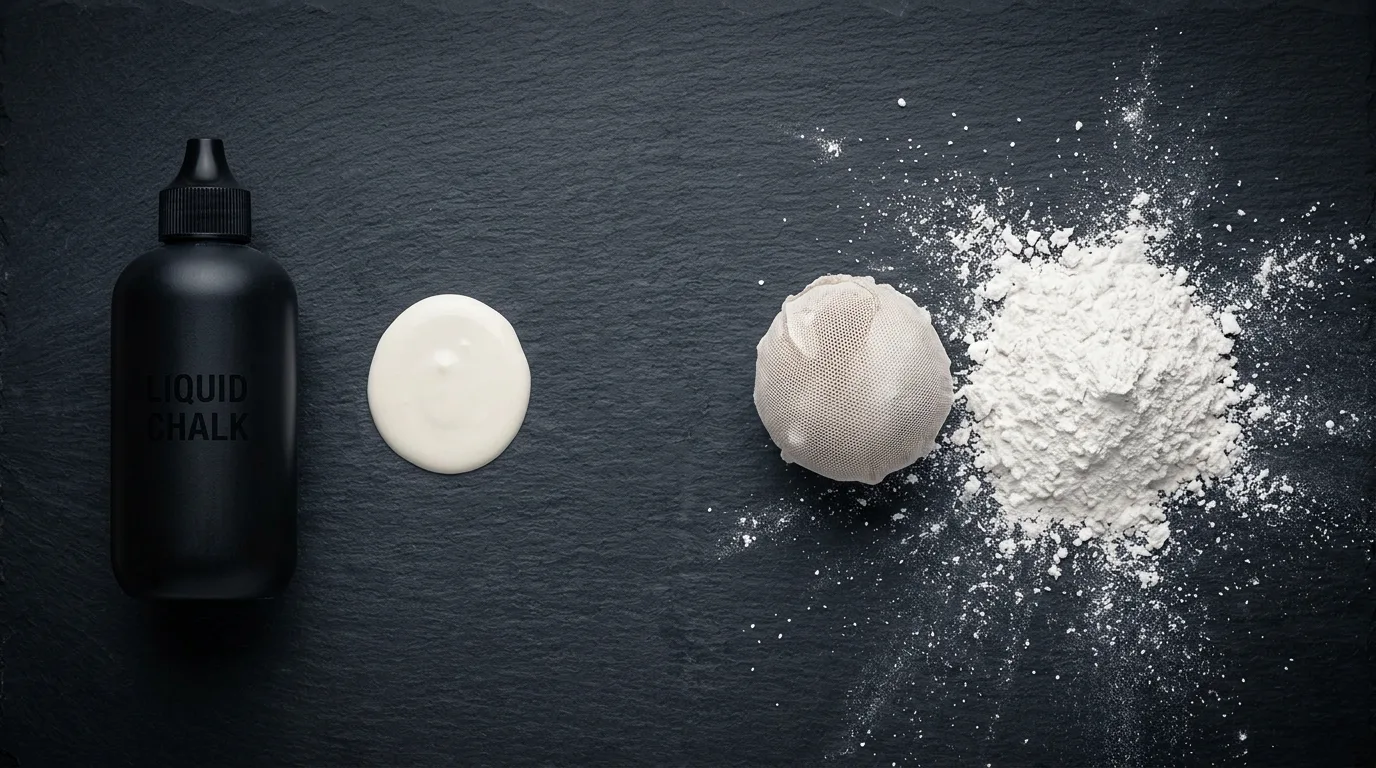
We compare the two formats across every dimension that matters to athletes: grip quality, grip duration, cleanliness, portability, gym acceptance, cost, convenience, and sport-specific performance. Both formats have genuine strengths. Both have real trade-offs.
How Each Format Works
Understanding the mechanism explains most of the performance differences.
Powder chalk: Loose or block magnesium carbonate applied directly to dry hands. The powder sits on the skin surface and absorbs moisture through direct contact. Application is instant — dip your hands in the bucket, clap off the excess, grip. The chalk stays on your skin through friction and gravity. It transfers easily to any surface you touch.
Liquid chalk: Magnesium carbonate suspended in an alcohol carrier. Squeeze it onto your palms, rub your hands together, and wait 10-30 seconds for the alcohol to evaporate. The evaporation process compresses the chalk particles against your skin, creating a bonded layer that resists transfer. The result is a thinner, more uniform coating that stays on your hands longer but takes time to apply.
The fundamental difference: powder chalk sits ON your skin. Liquid chalk bonds TO your skin. This distinction drives almost every practical difference between the two formats.
Grip Quality
The first question every athlete asks: which grips better?
Fresh application, single maximum effort: Powder chalk has a slight edge. A generous application of loose powder provides a thick, high-friction surface with maximum moisture absorption capacity. For a single heavy deadlift, a one-rep bench press, or a competition snatch, fresh powder chalk delivers marginally more surface friction than liquid chalk alone.
Sustained grip over multiple sets: Liquid chalk wins. The bonded layer resists transfer to equipment, meaning your second set has nearly as much chalk coverage as your first. Powder chalk transfers heavily on the first grip — by your second set, most of the chalk has moved from your hands to the barbell. You need to re-chalk after 1-2 sets with powder. With liquid chalk, a single application typically lasts 3-6 sets.
Even coverage: Liquid chalk wins. The alcohol carrier spreads the chalk across your entire palm as a uniform film. Every square centimeter gets the same coverage. Powder application is inherently variable — some spots get thick coverage, others stay bare, and clapping off excess creates an uneven distribution. Grip friction is limited by the weakest point of contact, so uniform coverage means more consistent performance.
The layering approach: The best grip comes from using both formats together. Apply liquid chalk as a base layer. Let it dry. Then add a light dusting of powder chalk on top. The liquid base creates a bonded foundation that extends the life of the powder layer on top. Sweat must penetrate both layers before reaching your skin. This is standard practice at competitive powerlifting and weightlifting events.
Cleanliness and Mess
The category where liquid chalk has the most decisive advantage.
Powder chalk mess: Every athlete who has used powder chalk knows the drill. White dust on your shirt, your shorts, the floor, the barbell, the bench, the rack, the mirror, and the air. Clapping your hands sends a visible cloud into the space around you. The dust settles on every surface within a 10-foot radius. Cleaning up after a powder chalk session — at home or at the gym — is a real chore.
Liquid chalk mess: Virtually none. The chalk bonds to your skin during the drying phase. Nothing becomes airborne. The only residue is a faint white mark on equipment you grip directly — and that wipes off with a towel in one pass. No dust on your clothes. No clouds in the air. No white footprints on the floor from stepping on spilled chalk.
This difference is not minor. It is the reason ~80% of commercial gyms allow liquid chalk while only ~30% allow powder. For home gym owners, it is the reason liquid chalk does not require daily mopping of your garage floor. For athletes who train at multiple facilities, it is the reason liquid chalk never creates a confrontation with gym staff.
Gym Acceptance
Directly tied to cleanliness, but worth its own section because it affects where you can train.
Powder chalk: Banned at most commercial gyms (Planet Fitness, many LA Fitness locations, many Anytime Fitness locations, and various other chains). Allowed at powerlifting gyms, Olympic lifting gyms, CrossFit boxes, climbing gyms, and home gyms. If your gym bans powder chalk and powder is your only option, you are either training without chalk or switching gyms.
Liquid chalk: Allowed at the vast majority of commercial and specialty gyms. The few exceptions are facilities with blanket no-chalk policies (some Planet Fitness locations, some boutique fitness studios). For most athletes, liquid chalk is the format that lets them use chalk regardless of where they train.
If you train at a single chalk-friendly facility (dedicated lifting gym, climbing gym, home gym), this category is irrelevant — use whichever you prefer. If you train at commercial gyms, travel to different facilities, or split time between a home gym and a commercial facility, liquid chalk eliminates the policy variable entirely.
Application Speed and Convenience
Powder chalk wins on speed. Liquid chalk wins on convenience.
Powder chalk application: 2-3 seconds. Reach into the chalk bucket, coat your hands, clap off excess, grip. No dry time. Immediate. For rapid-transition workouts (CrossFit WODs, circuit training, climbing sessions with quick route changes), the instant application of powder chalk is a genuine advantage.
Liquid chalk application: 15-30 seconds total. Squeeze product onto palm, rub hands together, wait for alcohol to evaporate. The dry time is non-negotiable — gripping the bar before the chalk has fully bonded produces a weak, smearing layer that wipes off on first contact. For planned lifting (you know your next set is in 2 minutes), the 15-30 second dry time is irrelevant. For timed workouts where you need chalk and grip within seconds, it requires planning your application a beat earlier than you would with powder.
Reapplication frequency: Liquid chalk requires fewer reapplications. A single application lasts 3-6 sets for most athletes (20-35 minutes of grip time). Powder chalk needs refreshing every 1-2 sets because it transfers to equipment on each grip. Over a 60-minute session, you might reapply liquid chalk 2-3 times vs reapplying powder chalk 8-12 times.
Portability
Liquid chalk wins decisively.
Powder chalk portability: Requires a chalk bag or sealed container. Loose powder in a gym bag eventually coats everything in that bag with white dust, regardless of how carefully you seal the container. Chalk bags take up space. Chalk blocks crumble into powder during transport. Traveling with powder chalk (especially flying) creates questions at security and risks mess in your luggage.
Liquid chalk portability: A 50ml bottle fits in a pocket. It clips to a gym bag strap with a carabiner. It cannot create a dust explosion if your bag tips over. For air travel, bottles under 100ml comply with TSA carry-on liquid rules. For athletes who train at multiple locations, travel for competitions, or simply want the smallest possible footprint in their gym bag, liquid chalk is the obvious choice.
Cost Per Application
Powder chalk is cheaper. But both formats are inexpensive enough that cost should not be the primary deciding factor.
Powder chalk cost: A one-pound (454g) block of gym chalk costs a few dollars. At approximately 1-2 grams per application, that is 200-400+ applications per block. Even the most heavily chalking powerlifter will get months of daily use from a single block. The cost per application is fractions of a cent.
Liquid chalk cost: A mid-range 50ml bottle provides 30-60 applications. A 250ml bottle provides 200-400 applications. Even at the premium end of the market, the cost per workout session ranges from a few cents to about fifty cents. Buying 250ml bottles brings the per-application cost much closer to powder chalk.
The hidden costs of powder chalk: Chalk bags need replacing when they wear out or get lost. Gym cleaning costs (if you own a home gym) add up — powder chalk requires regular mopping. Gym membership restrictions (if your gym bans powder and you need to switch to a lifting-focused gym) can cost hundreds of dollars per year more. These indirect costs can exceed the price difference between formats.
Grip Duration and Weather Conditions
Performance in different environments varies between the two formats.
Dry, moderate conditions (indoor gym, 20-25°C): Both formats perform well. Liquid chalk lasts longer per application. Powder chalk provides marginally higher peak friction. For most indoor training, neither format has a meaningful advantage over the other.
Hot and humid conditions: Liquid chalk degrades faster because the chalk layer must absorb both your sweat and ambient moisture from the air. But powder chalk degrades even faster — sweat washes loose powder off the skin surface in minutes. In humid environments, liquid chalk's bonded layer outperforms powder's surface-sitting layer because the bond resists being washed away by sweat.
Cold conditions: Liquid chalk dries slower in the cold because lower temperatures slow alcohol evaporation. Allow 30-40 seconds instead of the usual 15-20. Powder chalk is unaffected by temperature and applies at the same speed regardless of conditions. For outdoor winter climbing, powder chalk in a chalk bag is more practical than waiting for liquid chalk to dry with cold hands.
Rainy or wet conditions (outdoor climbing): Neither format works well on wet skin. Both require dry hands for application. Powder chalk is easier to reapply repeatedly in varying conditions because there is no dry time — but it also washes away faster in rain. Liquid chalk's bonded layer provides slightly more resilience against intermittent moisture. For wet conditions, advanced formulas with rosin or nano-resins outperform both standard liquid and standard powder.
Skin Impact
Both formats dry your skin. The mechanisms differ.
Powder chalk: Magnesium carbonate absorbs moisture from your palms continuously during use. Over a long session, this creates noticeable dryness. The gritty texture of loose powder can also aggravate calluses during dynamic movements (bar rotation in Olympic lifts, swinging on a pull-up bar), contributing to callus tears.
Liquid chalk: The alcohol carrier strips moisture during application — a temporary but noticeable drying effect. After the alcohol evaporates, the remaining chalk layer absorbs sweat like powder chalk does. The bonded layer creates a smoother friction surface than loose powder, reducing the grabbing action that tears calluses. Many high-rep athletes (CrossFitters, kettlebell sport athletes) report fewer hand tears after switching from powder to liquid.
Post-training skin care: The same recommendation applies regardless of format. Wash your hands thoroughly after training, then apply an unscented hand moisturizer. Daily chalk use without moisturizing leads to cumulative dryness, cracking, and skin splitting — especially on callused areas. A 30-second moisturizing step prevents this entirely.
Hygiene
Liquid chalk wins. By a wide margin.
Powder chalk (shared bucket): A communal chalk bucket is a bacterial transfer medium. Multiple athletes dipping sweaty hands into the same container creates ideal conditions for transmitting skin infections — ringworm, staphylococcus, impetigo, and other gym-acquired infections are well-documented in facilities with shared chalk.
Liquid chalk (personal bottle): Each athlete uses their own bottle. No shared contact surface. The alcohol carrier provides a mild antimicrobial effect during every application. From a hygiene perspective, personal liquid chalk is one of the simplest upgrades an athlete can make in a shared training environment.
Even in chalk-friendly gyms with powder chalk available, many athletes now carry personal liquid chalk bottles for this reason alone. The hygiene advantage is real and not trivial — skin infections from gym contact are common enough to have dedicated medical literature.
The Bottom Line: When to Use Each
Use liquid chalk when:
- Your gym restricts powder chalk
- Cleanliness matters (commercial gym, home gym, shared equipment)
- You want longer grip duration with fewer reapplications
- You travel with your chalk (gym bag, air travel, competitions)
- Hygiene is a priority (shared training space)
- You want a smoother, more even friction surface (high-rep training, reducing callus tears)
Use powder chalk when:
- Instant application matters (timed workouts, rapid transitions)
- Maximum peak friction for a single heavy lift is the priority
- You train outdoors in cold or wet conditions where dry time is impractical
- Gymnastics or apparatus work requires thick, full-surface coverage
- Budget is the primary concern and you train in a chalk-friendly facility
- Tradition and ritual matter to your pre-lift mental preparation
Use both when:
- Competition day — liquid chalk base + powder top coat for maximum grip
- Heavy training sessions — liquid chalk for working sets, add powder for your top sets
- Multi-pitch climbing — liquid chalk at the base, chalk bag for reapplication on the wall
- Any scenario where you want the best possible grip regardless of format loyalty
The formats are not competitors — they are complements. The most effective grip strategy uses both where each excels. The only reason to choose one exclusively is external: gym policy, portability needs, or personal preference for simplicity.
Liquid vs Powder: Your Questions
Is liquid chalk better than powder chalk?
For gym-friendliness and portability, liquid chalk wins clearly. For absolute peak friction on a single maximum-effort lift, a fresh powder application has a marginal edge. Most athletes get the best results by using liquid chalk as a base layer and adding powder on top for their heaviest sets — the two formats complement each other rather than competing.
Why do some lifters prefer powder chalk over liquid?
Familiarity, tactile feedback, and tradition. Powder chalk provides an immediate sensory confirmation (you can feel the dry powder on your skin), applies instantly with no dry time, and has been the standard in strength sports for decades. Some lifters also prefer the ritual of chalking up from a bucket — it is part of their pre-lift routine and mental preparation.
Can I use liquid and powder chalk together?
Yes, and many competitive athletes do exactly this. Apply liquid chalk as a base layer, let it dry for 15-20 seconds, then add a light dusting of powder chalk on top. The liquid base extends the life of the powder layer because sweat must penetrate two barriers. This is standard practice among powerlifters and competition climbers.
Does liquid chalk work as well as powder for climbing?
For most climbing situations, liquid chalk provides excellent grip. Indoor sport climbing, bouldering sessions under 45 minutes, and moderate-difficulty routes are all well-served by liquid chalk alone. For multi-pitch trad climbing, endurance routes, or extremely hot/humid conditions where reapplication matters, many climbers carry a chalk bag with powder as backup alongside their liquid chalk base.
Which is cheaper per use — liquid or powder?
Powder chalk is cheaper per application. A one-pound block of gym chalk costs a few dollars and provides hundreds of applications. A mid-range 50ml liquid chalk bottle provides 30-60 applications at a higher per-unit cost. But the total cost of either format is low enough that price should not be the deciding factor — choose based on your gym policy, sport, and personal preference.
Does liquid chalk expire faster than powder chalk?
Yes. Powder chalk (solid magnesium carbonate) is a stable mineral that lasts indefinitely when stored dry. Liquid chalk has a shelf life of 12-24 months after opening because the alcohol carrier gradually evaporates through the cap seal, thickening the formula. A sealed bag of powder chalk will perform identically whether it is 1 month old or 10 years old.
Track Both Products
We'll email you if either price drops or availability changes.
Only when something changes. Unsubscribe anytime.