Liquid Chalk Travel Rules: TSA, Airlines & International Regulations
Flying with liquid chalk is straightforward once you understand one rule: it is a liquid. TSA, EASA, and every major aviation authority treat it identically to hand sanitizer, shampoo, and contact lens solution. Here is exactly how to pack it for carry-on, checked bags, and international flights — plus what to do when security asks questions.
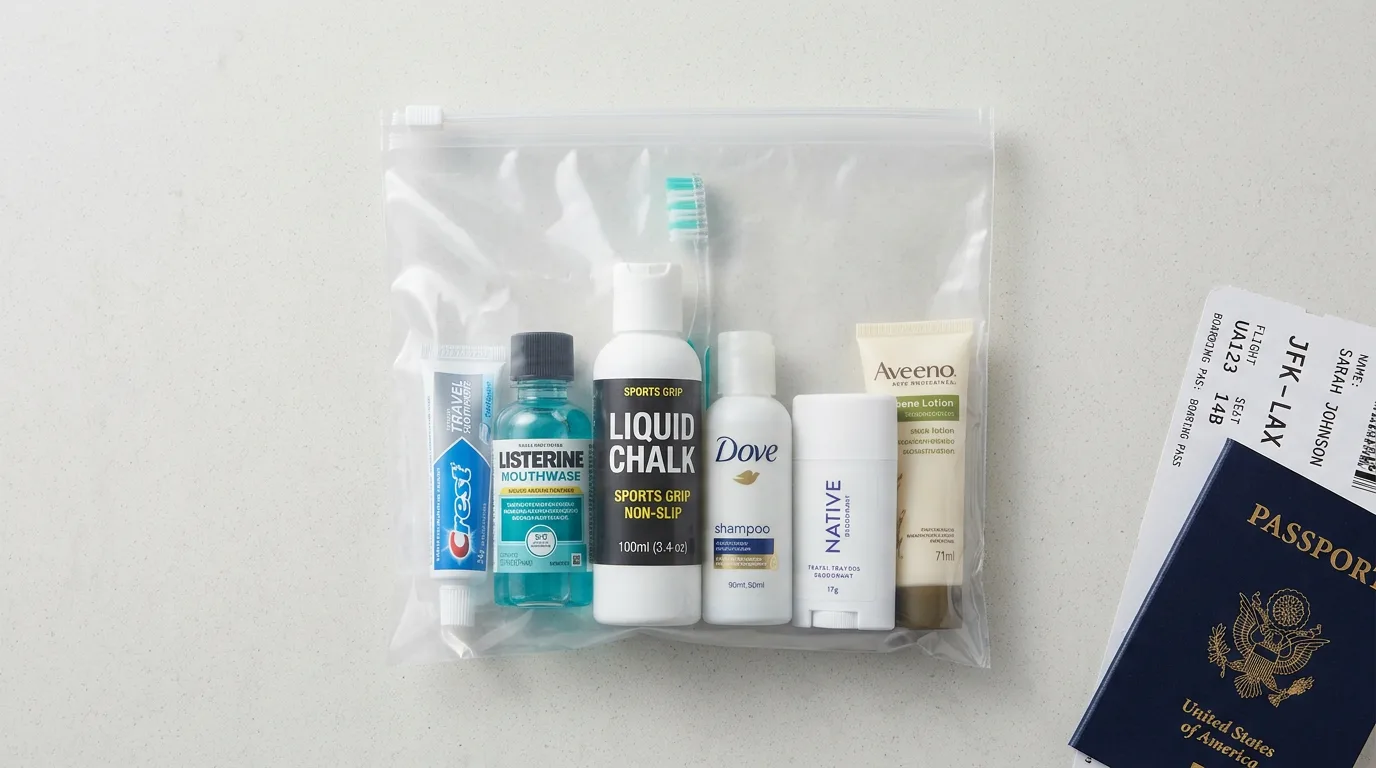
Athletes who compete, train at destination gyms, or hit climbing crags on vacation face the same question every trip: can I bring my chalk? The answer is yes — but the details depend on the format (liquid vs powder), the container size, and where you are flying. This guide covers every scenario.
TSA Rules for Liquid Chalk in Carry-On Bags
The Transportation Security Administration applies the 3-1-1 rule to all liquids, gels, creams, and pastes in carry-on bags. Liquid chalk falls squarely into this category. The rule is simple: each container must be 3.4 ounces (100ml) or smaller, and all containers must fit inside one quart-sized clear plastic bag.
Most travel-sized liquid chalk bottles are 50ml or 60ml — well under the limit. Standard gym-size bottles (200-250ml) exceed the limit and must go in checked luggage. There is no exception for athletic products, medical reasons, or competition needs. The 100ml cap applies regardless of how much liquid is actually left in the bottle. A half-empty 250ml bottle still fails because the container size exceeds the threshold.
To fly with liquid chalk in carry-on, pack the bottle in your clear quart-sized bag alongside your other liquids. Place it in the bin during screening the same way you would any toiletry. In practice, most TSA agents do not give liquid chalk a second look — the bottle resembles a travel-sized lotion or hand sanitizer, which they process thousands of times per shift.
Checked Luggage: No Size Restrictions
Checked bags have no TSA liquid volume restriction for individual containers. You can pack a full 250ml bottle, multiple bottles, or a bulk supply without any regulatory concern. The only practical limit is the weight allowance on your checked bag.
The risk with checked luggage is leakage. Cargo holds are pressurized but experience altitude-related pressure changes during ascent and descent. Liquid chalk bottles — especially those with flip-top or squeeze caps — can leak if the cap is not fully secured. The alcohol content means a leak will also affect surrounding items in your bag.
Seal the cap tightly, place the bottle in a zip-lock bag, and pack it surrounded by soft items (clothing, towels) that can absorb any potential leak. Standing the bottle upright helps, but baggage handling makes orientation unpredictable. The zip-lock bag is your real protection.
Powder Chalk and Air Travel
Powder chalk creates a different set of challenges at airport security. TSA does not explicitly ban it, but loose white powder in a plastic bag looks suspicious on an X-ray screen. Agents may pull your bag for secondary inspection, open the container, and test the powder for explosive residue. This process takes 5-15 minutes and is not guaranteed to end with the chalk being allowed through.
The practical recommendation: leave powder chalk in checked luggage or ship it ahead to your destination. For carry-on, liquid chalk eliminates the security friction entirely. A sealed, labeled bottle of liquid chalk looks like any other personal care product and passes through screening without question in the vast majority of cases.
Chalk balls (powder chalk inside a mesh fabric ball) fall into a gray area. They are solid enough to avoid the "loose powder" concern, but some agents classify them as powders and flag them. If you need chalk in carry-on, liquid is the safest format.
International Travel Regulations
Most countries follow the International Civil Aviation Organization (ICAO) liquid rules, which mirror the TSA 3-1-1 standard: liquids in carry-on must be in containers of 100ml or less, placed in a transparent resealable bag of approximately 1 liter capacity.
European Union (EASA): Follows ICAO standard. Liquid chalk under 100ml is permitted in carry-on inside the clear bag. EU security tends to be more methodical about checking the clear bag contents — make sure the chalk bottle is clearly labeled.
United Kingdom: Same 100ml rule. UK airports have recently introduced CT scanners at some terminals (Heathrow, Gatwick) that allow liquids to stay in bags during screening. Where available, this means you don't need to remove your clear bag — but the 100ml container limit still applies.
Australia and New Zealand (CASA): ICAO standard applies. Australian domestic flights have the same liquid restrictions as international flights, which differs from US domestic policy (where the 3-1-1 rule technically applies to all flights but enforcement varies).
Japan: Follows ICAO with strict enforcement. Japanese airport security is thorough — expect your clear bag to be visually inspected. Clearly labeled products in commercial packaging pass without issues.
Middle East and Africa: Regulations follow ICAO, but enforcement varies by airport. Some airports in the Gulf states (Dubai, Doha, Abu Dhabi) have stricter interpretation and may question unfamiliar products. Having a clearly labeled commercial bottle reduces questions. Airports in parts of Africa may have less standardized enforcement — bring documentation if possible.
Competition Travel: Planning Ahead
Athletes traveling to powerlifting, weightlifting, or climbing competitions have higher stakes. Running out of chalk or having your preferred product confiscated at security can disrupt preparation. A few strategies minimize this risk.
First, bring two bottles: one travel-sized in carry-on and one full-sized in checked luggage. If either bag is lost or delayed, you still have chalk. Second, check whether the competition venue provides chalk. Most sanctioned powerlifting and weightlifting meets supply chalk at the platform. Climbing competitions provide chalk at isolation. Your personal bottle is a backup, not the only option.
Third, research availability at your destination. In major markets (US, Canada, UK, EU, Australia, Japan), liquid chalk is available at sporting goods retailers and Amazon with fast shipping. Arriving a day early and ordering online is a viable backup strategy. In smaller markets, availability is less certain.
Shipping Liquid Chalk Instead of Flying With It
For trips where you need multiple bottles or larger quantities, shipping ahead can be easier than packing. USPS, UPS, and FedEx all ship liquid chalk domestically without restrictions — it is not classified as a hazardous material in the quantities you would typically send (under 1 liter).
International shipping is more variable. Some countries restrict importing alcohol-based products. Customs declarations should accurately describe the contents ("athletic grip chalk, magnesium carbonate in isopropyl alcohol"). Misdeclaring contents risks seizure at customs. For destinations where importation rules are unclear, buying locally or through Amazon's international marketplace is often simpler.
Hotels and Airbnb hosts will generally accept packages on your behalf if you arrange it in advance. Ship 3-5 days before arrival to account for transit delays, and include tracking so you can confirm delivery before you fly.
What to Do If Security Questions Your Chalk
It happens occasionally. A TSA agent or international security officer picks up your liquid chalk bottle and is not sure what it is. The interaction is usually brief, but handling it calmly speeds the process.
Explain that it is athletic grip chalk used for weightlifting or rock climbing. Point out the label — most commercial products clearly state "liquid chalk" or "grip chalk" on the front. Offer to open the bottle and let the agent smell it (the alcohol scent is immediately identifiable). If the agent wants to test it, cooperate. The standard swab test for explosives clears liquid chalk immediately.
The scenario to avoid: carrying an unlabeled, homemade bottle of white liquid through security. That invites questions that a clearly labeled commercial product does not. Keep products in their original packaging whenever possible.
Train Travel, Bus Travel, and Driving
Non-aviation transport has no liquid restrictions for personal products. You can bring any size, any quantity of liquid chalk on trains (Amtrak, Eurostar, JR, etc.), buses, ferries, and in your car. No special packaging or labeling is required.
The only consideration is temperature. Liquid chalk stored in a hot car trunk during summer months can experience formula changes — the alcohol evaporates faster from bottles that are not perfectly sealed, and some products may separate or thicken. Store chalk in the climate-controlled cabin during extreme heat, or at least in an insulated bag.
Packing Liquid Chalk: A Quick Reference
Here is the practical summary for every travel scenario:
Carry-on (domestic US): Bottles under 3.4 oz (100ml) in your clear quart bag. Most travel sizes (50-60ml) are compliant.
Carry-on (international): Same 100ml rule under ICAO. Commercial packaging recommended. Check destination-specific enforcement if traveling to less common markets.
Checked bag (any flight): No size limit. Seal in a zip-lock bag. Pack cushioned. The alcohol content falls within FAA flammable liquid personal care exemptions.
Train, bus, car: No restrictions. Protect from extreme heat.
Shipping ahead: Domestic shipping unrestricted. International shipping may require accurate customs declaration. Ship 3-5 days early with tracking.
Competition travel: Pack a travel bottle in carry-on plus a full bottle in checked luggage. Verify venue chalk availability as a backup.
Travel-Ready Chalk: Questions Answered
Can I bring liquid chalk in my carry-on bag?
Yes. TSA classifies liquid chalk as a liquid/gel. Containers must be 3.4 oz (100ml) or smaller and fit inside your quart-sized clear toiletry bag. Most travel-size bottles (50ml-60ml) meet this requirement easily. Pack it the same way you would pack hand sanitizer or contact lens solution.
Is there a limit to how much liquid chalk I can put in checked luggage?
Checked bags have no TSA liquid volume restriction for individual containers. You can pack full-size 250ml bottles, multiple bottles, or even bulk chalk. The only limit is the airline weight allowance for your checked bag. Seal bottles in a zip-lock bag to prevent leaks from pressure changes during flight.
Will liquid chalk set off TSA screening?
Liquid chalk rarely triggers additional screening when it is in a properly labeled commercial bottle inside your clear toiletry bag. The bottle looks similar to hand sanitizer or lotion, which TSA agents see thousands of times daily. Unlabeled or homemade bottles in unmarked containers may get a closer look. Keep the original packaging if possible.
Can I bring powder chalk on a plane?
TSA does not explicitly ban powder chalk, but loose white powder in a bag can trigger secondary screening. It may be tested for explosive residue. To avoid delays, pack powder chalk in checked luggage inside a sealed container. For carry-on, liquid chalk is far less likely to cause questions at security.
Do international airports follow the same liquid chalk rules?
Most international airports follow ICAO guidelines, which mirror TSA rules: liquids under 100ml in carry-on, placed in a clear resealable bag. Europe (EASA), UK, Australia (CASA), Japan, and most Asian countries follow this standard. Some Middle Eastern and African airports have stricter enforcement — check your specific destination before flying.
Can I buy liquid chalk at my destination instead of traveling with it?
In major cities across North America, Europe, and Australia, liquid chalk is available at climbing gyms, sporting goods stores, and Amazon with next-day delivery. In smaller markets or developing countries, availability is unreliable. If you are competing abroad, bring your own tested product — switching brands before competition day introduces unnecessary variables.
Get Grip Tips Delivered
One email per week. Honest reviews, no spam.
Only when something changes. Unsubscribe anytime.