Liquid Chalk for Rock Climbing: Crag-Ready Grip Solutions
Rock climbing demands grip endurance across minutes of sustained contact — not seconds. A single pitch on sandstone or granite might keep your hands on the wall for 10-20 minutes straight, and the difference between sending and falling often comes down to whether your fingertips held friction through one more move. Liquid chalk gives rock climbers a base coat of magnesium carbonate that bonds directly to the skin, absorbs sweat before it reaches the rock surface, and lasts through multiple sequences without the need to reach into a chalk bag mid-crux. This guide breaks down application strategy by climbing discipline, rock type considerations, indoor versus outdoor approaches, and the formulas that perform best on real rock.
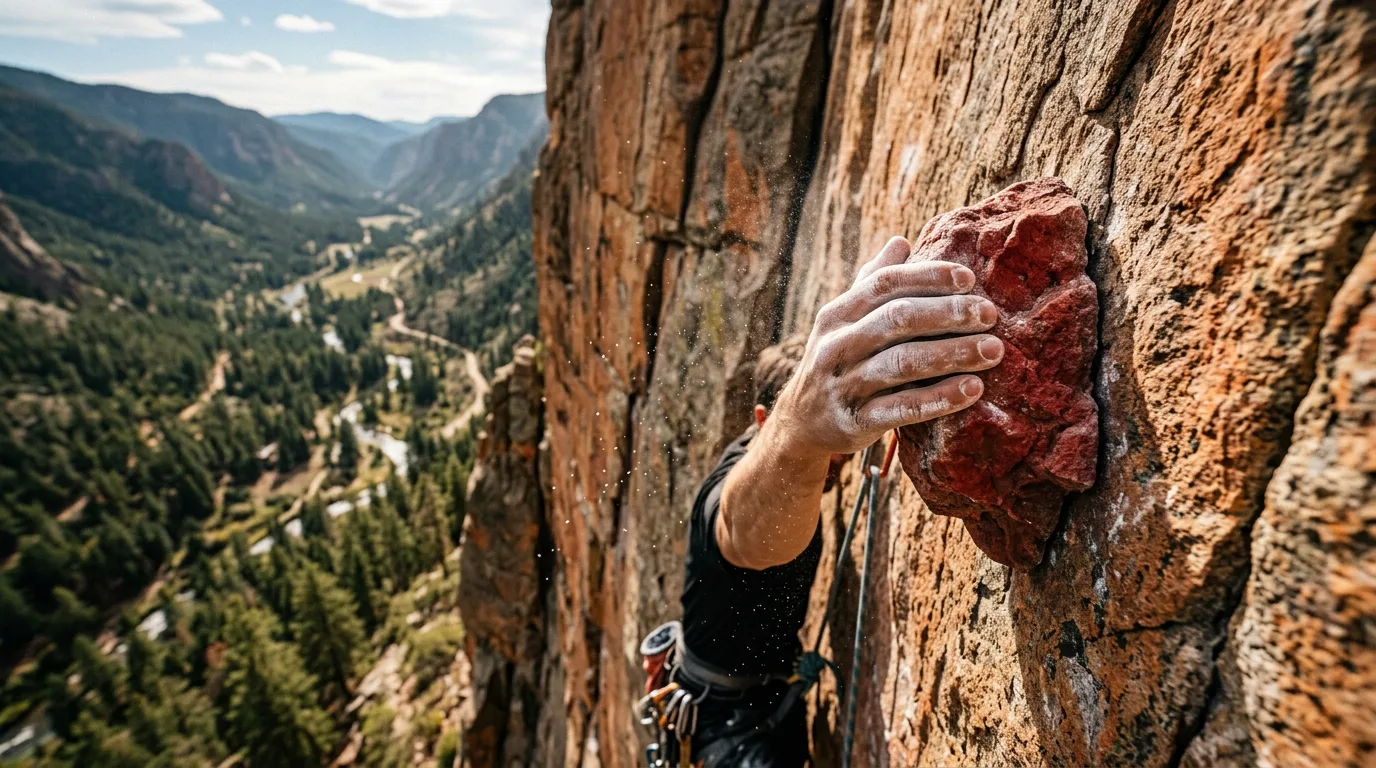
Why Rock Climbers Are Switching From Chalk Bags
The traditional chalk bag has been the default for decades — dip, dust, climb. But that routine has problems that become obvious once you analyze what actually happens at the point of contact. Loose chalk creates an uneven layer. Some areas of your palm get thick deposits while fingertips barely get dusted. The chalk flakes off during the first few moves, leaving exactly the spots that need grip the most with the least coverage. And on routes where you cannot reach your chalk bag — roof sections, pumpy traverses, sustained overhangs — you climb with whatever coating survived the opening moves.
Liquid chalk changes the application model entirely. The alcohol-suspended magnesium carbonate spreads evenly across every surface of your hand. When the alcohol evaporates — usually within 15-30 seconds depending on ambient temperature — the chalk bonds to your skin rather than sitting loosely on top. This bonded layer stays through dynamic moves, hand jams, crimps, and slopers. It does not transfer to the rock as heavily as loose chalk, reducing hold polishing on popular routes. And it eliminates the midroute chalk bag routine that costs time and energy on timed redpoint burns.
The shift is not about abandoning chalk bags entirely. Multi-pitch climbers still carry supplementary loose chalk. But the base coat strategy — liquid chalk applied at the base, topped up from a bag only when needed — has become the standard approach for performance-focused climbers from gym-trained sport climbers to weekend trad warriors.
Sport Climbing: Sustained Friction Over Full Pitches
Sport climbing tests grip endurance more than any other discipline. A 30-meter route might take 5-15 minutes depending on grade and style, and your hands stay on the wall the entire time. Loose chalk applications that fade within 2-3 minutes leave you fighting slippery holds through the crux — typically positioned at the route's hardest section, two-thirds up the wall, exactly where chalk coverage fails.
Apply liquid chalk before leaving the ground. Squeeze a dime-sized amount onto your palms, spread it across fingers and thumbs, and let it dry completely — fully white and powdery to the touch. This takes 20-40 seconds in normal temperatures. The bonded base coat handles the first half of most sport routes without supplementation. If you clip a bolt at a good rest position and feel moisture building, a quick dip into a chalk bag refreshes the top layer without removing the liquid base underneath.
For redpoint burns where every second matters, liquid chalk eliminates the chalk-up time tax. Belayers at Smith Rock, Kalymnos, and the Red River Gorge have reported climbers shaving 15-30 seconds off attempt times simply by removing two or three midroute chalk stops. On onsight attempts where pump clock is ticking, those saved seconds are the difference between clipping chains and the fall.
Trad Climbing: Jams, Cracks, and Multi-Pitch Logistics
Traditional climbing adds complexity because the grip shapes go far beyond face holds. Hand jams in finger cracks, fist jams in off-widths, and ring locks in parallel-sided splitters all require chalk coverage in different areas. A face climber chalks their fingertips and palm friction pads. A crack climber needs coverage across the back of the hand, the thumb web, and the wrist — surfaces that loose chalk rarely reaches.
Liquid chalk solves the coverage problem. Because you spread it manually, you can coat the backs of hands, thumb webs, and wrist areas that contact crack walls. A hand jam in Indian Creek sandstone seats better when the entire hand surface has a moisture-absorbing layer, not just the palm side. The bonded film also acts as a minor skin protectant — it will not prevent gobies from aggressive jams, but it reduces the skin abrasion from minor shifting inside the crack.
Multi-pitch logistics are where the hybrid approach matters most. Liquid chalk is your belay ledge application. At each anchor, pull the bottle from your pack or harness, apply a fresh coat while your partner leads, and start the next pitch with full coverage. Between anchors, a lightweight chalk bag or chalk sock handles midpitch touch-ups. The liquid base means you need fewer chalk bag dips, which means less gear fumbling on exposed stances.
How Rock Type Changes Your Chalk Strategy
Not all rock responds identically to chalk, and matching your approach to the surface saves both product and frustration. The mineral composition, grain size, porosity, and surface texture of the rock all affect how chalk interacts at the friction interface.
Granite
Coarse crystal structure provides natural mechanical friction. Liquid chalk works exceptionally well — the rough surface grips even with a thin application. Use less product per application than you would on smoother stone. One coat lasts longer on granite than any other rock type because the natural texture supplements chemical friction.
Sandstone
Porous surface absorbs chalk into the stone itself, requiring more frequent reapplication. Apply a slightly thicker initial coat to compensate for absorption. On soft sandstone like at Red Rocks, the rock wears down with use — liquid chalk's thinner deposit profile reduces hold polishing compared to packed loose chalk in pockets.
Limestone
Polished limestone pockets are the ultimate grip test. The smooth surface offers minimal mechanical friction, making chemical friction from chalk the primary grip factor. Use a high-MgCO3 formula and let it dry completely. On tufa features, chalk builds up in the pocketed texture — liquid chalk deposits less residue in these intricate shapes than packed loose chalk.
Volcanic Rock
Basalt, rhyolite, and volcanic tuff have extremely sharp crystal textures that provide aggressive mechanical grip. You need the least chalk on volcanic rock. A thin liquid chalk application is more than sufficient. Heavy chalk application on sharp volcanic holds actually reduces grip by filling the micro-texture gaps that create friction.
Indoor Training: Gym Walls and Plastic Holds
Indoor climbing walls are where most climbers first encounter liquid chalk — often because their gym requires it. Commercial climbing gyms manage chalk dust as an air quality and cleaning expense. A busy climbing gym with 200+ climbers per day using loose chalk generates visible particulate clouds that coat surfaces, clog HVAC filters, and triggers complaints from non-climbing tenants in shared buildings. Liquid chalk reduces airborne particles by an estimated 90% according to gym operators who have tested both.
On plastic holds, liquid chalk performs differently than on rock. Polyurethane and polyester resin holds have a textured surface designed to simulate rock friction, but the material itself does not absorb moisture. Sweat sits on the hold surface rather than soaking in. This means the chalk on your hands is the entire friction system — there is no supplemental rock texture helping you grip. A solid liquid chalk coat matters more indoors than outdoors because the hold material provides less natural friction assistance.
Reset days change the equation. Freshly set holds have maximum texture — the factory surface coating is intact and friction is high. After thousands of touches over weeks, holds polish smooth. If your gym project is on old holds, you need more chalk and better coverage than on fresh sets. Pay attention to hold age as a variable in your session performance.
Application Technique for Climbers
Climbing demands more precise chalk application than most sports because different grip types load different parts of the hand. A crimper loads fingertip pads and the DIP joint. An open-hand sloper grip loads the entire palm friction surface. A pinch loads the thumb pad and opposing fingers. Covering all these surfaces requires deliberate application.
Start with a nickel-sized dollop — roughly 1-2ml depending on hand size. Rub it between your palms first to distribute the base, then work it into each finger individually, pressing the chalk into the skin of your fingertips, the sides of each finger, and the thumb pad. Spread any remaining product across the back of your hands if crack climbing. The entire process takes 30-45 seconds, and you should see a uniform white film with no wet spots when finished.
For outdoor climbing in cold conditions below 10 degrees Celsius (50 degrees Fahrenheit), the alcohol in liquid chalk evaporates slower. Give it an extra 15-20 seconds of drying time before touching rock. In hot conditions above 30 degrees Celsius (86 degrees Fahrenheit), the opposite happens — fast evaporation means you need to spread the chalk quickly before it dries on one hand with nothing left for the other. Work fast in heat, be patient in cold.
The Environmental Angle: Impact on Rock and Access
Chalk marks on rock faces have become a contentious access issue at crags worldwide. At popular areas like Fontainebleau, Joshua Tree, and the Grampians, white chalk streaks on boulders are visible from hundreds of meters away. Land managers and conservation groups have raised valid concerns about visual impact, particularly in wilderness areas where "leave no trace" principles apply. Some areas — notably parts of Australia, Japan, and specific US wilderness zones — have enacted chalk bans or restrictions.
Liquid chalk offers a meaningful reduction in visible impact compared to loose chalk. The bonded film deposits less material on the rock surface per contact. Where a loose chalk user might leave a visible white handprint on every hold, a liquid chalk user leaves a thinner film that weathers away with the next rainfall cycle. This is not zero impact — any chalk use marks the rock temporarily. But in the access negotiation between climbers and land managers, the lower impact profile of liquid chalk has been a key argument for maintaining climbing access at sensitive areas.
Color-matching chalk products have emerged for climbers who want to minimize visual impact further. These use iron oxide pigments to approximate sandstone, granite, or limestone tones. When combined with a liquid chalk base coat, the overall visual footprint drops even further. If you climb at access-sensitive areas, this combination demonstrates good stewardship that supports the climbing community's relationship with landowners and park services.
Best Liquid Chalk Products for Rock Climbing
Climbing puts unique demands on liquid chalk — you need a formula that bonds under variable temperatures, resists transfer to rock surfaces, and provides friction on both indoor holds and outdoor stone. These picks address those climbing-specific requirements based on formula composition and field performance.
Spider Chalk Black Widow 4oz — Best for Outdoor Routes
The black-tinted formula reduces visible chalk marks on dark rock — granite, basalt, and dark limestone all benefit from the minimal visual footprint. High magnesium carbonate concentration provides strong friction that holds through long sport pitches. At mid-range, it delivers serious performance for dedicated outdoor climbers.
Check Price on AmazonEVMT Brands Liquid Chalk — Best for Gym Sessions
Quick-drying formula works well on plastic holds where surface friction is entirely chalk-dependent. Thin application that does not gunk up hold texture. The compact bottle fits in a chalk bucket or gym bag side pocket. Priced at affordably priced, it is practical for high-frequency gym climbers who apply multiple times per session.
Check Price on AmazonWARM BODY COLD MIND Liquid Chalk — Best for Cold Weather Crags
Formulated with skin-conditioning additives that keep hands supple in cold, dry conditions — a real factor on fall and winter sends. The alcohol evaporation rate is balanced for moderate temperatures without leaving wet spots in cold air. At mid-range, the skin care benefit justifies the investment for climbers who session through cold seasons.
Check Price on AmazonChalkless Grip Enhancer CLEAR — Best for Sensitive Crags
Clear formula leaves zero visible marks on rock — the ultimate choice for areas with chalk use concerns. No white residue on holds, no visible handprints, no impact on rock aesthetics. Grip performance is competitive with traditional white formulas on both indoor and outdoor surfaces. Priced at top-tier.
Check Price on AmazonOUTTDOZ Liquid Chalk — Best Budget Option for Regular Climbers
Solid magnesium carbonate formula at budget-friendly that handles both gym and outdoor sessions without draining your climbing budget. The consistency is good for beginners learning application technique — not too thick, not too runny. A reliable daily driver for climbers who go through chalk quickly during frequent sessions.
Check Price on AmazonSkin Management for Climbers Who Use Liquid Chalk
Liquid chalk's alcohol base strips skin oils with every application. For climbers who train 3-5 times per week, this creates a paradox: the chalk that prevents grip failure also dries out the skin that generates friction. Healthy, supple skin with good texture grips better than dessicated, cracked skin — even with chalk.
Post-session skin care is non-negotiable for regular climbers. Within 30 minutes of finishing, wash hands with mild soap and apply a climbing-specific balm or general-purpose moisturizer. Products with beeswax or lanolin create a protective barrier that locks moisture in without making skin slippery. Avoid petroleum-based products the night before climbing — they leave a residue that chalk cannot penetrate.
Callus management interacts with chalk strategy. Thick, raised calluses catch on holds and tear. Thin, uniform calluses provide a durable friction surface. File calluses flat with a pumice stone or sandpaper after showers — never tear them. Liquid chalk bonds more uniformly to smooth, well-maintained calluses than to rough, peaked ones. Skin care is not vanity for climbers. It is performance maintenance.
Mistakes That Cost Climbers Sends
These errors surface repeatedly at crags and gyms. Each one reduces grip performance in ways the climber often does not connect to their chalk routine.
Applying to wet hands. If your hands are already sweating, towel them dry before applying liquid chalk. The alcohol cannot evaporate properly through a layer of existing moisture. The result is a patchy, weak coat that fails within minutes. Dry first, then apply.
Not drying completely before touching rock. That 20-30 second wait is real. Grabbing a hold before the alcohol evaporates produces a smeary, wet grip that is worse than no chalk at all. The alcohol itself acts as a lubricant until it dries. Wait for the white, powdery finish.
Over-applying on textured rock. Granite and volcanic rock already provide mechanical friction. Thick chalk layers fill the micro-texture that creates grip. On rough rock, use half the amount you would on smooth limestone or plastic. Let the rock do its job.
Ignoring hold condition. Packed chalk, rubber deposits, and skin oils accumulate on popular routes. No amount of chalk on your hands compensates for a glazed hold surface. Brush holds before your attempt. A boar's hair brush in your chalk bag is worth more than a premium chalk upgrade.
Same amount on every rock type. Limestone pockets demand more chalk than granite face. Sandstone absorbs chalk and needs frequent reapplication. Volcanic rock needs almost none. Adjust volume to the stone, not a fixed routine.
Liquid Chalk for Rock Climbing: Your Questions
Can liquid chalk fully replace a chalk bag on multi-pitch routes?
For single-pitch routes and gym sessions, yes. On multi-pitch routes over 4-5 pitches lasting 2+ hours, carry a small chalk bag as backup. Liquid chalk reapplication mid-pitch is impractical with one hand on the wall, while a chalk bag lets you dip between moves. Many trad climbers use liquid chalk as a base coat at the belay and supplement with loose chalk from a bag on the wall.
Does liquid chalk leave marks on outdoor rock faces?
Less than loose chalk but not zero impact. Liquid chalk deposits a thinner film that weathers away faster — typically within 2-3 rain cycles on sandstone, faster on granite. Loose chalk leaves visible white streaks that persist for months. For ethical climbing at sensitive crags, liquid chalk is the lower-impact choice. Some climbers at places like Hueco Tanks use colored chalk that matches the rock for minimal visual impact.
Which liquid chalk formula works best in humid outdoor conditions?
High-alcohol formulas with rosin additives perform best in humidity above 70%. The rosin creates a tackier film that resists moisture absorption from the air. Pure magnesium carbonate formulas lose effectiveness faster in humid conditions because the MgCO3 absorbs atmospheric moisture before your sweat even reaches it. Check the ingredient list for "pine rosin" or "tree resin" as indicators.
Is liquid chalk allowed at climbing competitions?
IFSC rules permit liquid chalk at all World Cup and World Championship events. Most regional competition circuits follow IFSC standards. The main restriction is on additives — some competitions ban rosin-based formulas because they leave residue on holds that affects subsequent climbers. Pure magnesium carbonate liquid chalk is universally accepted. Check event-specific rules for any additive restrictions.
How does rock type affect liquid chalk performance?
Granite and its coarse texture pairs well with any liquid chalk — the rough surface provides mechanical grip alongside chemical friction. Sandstone absorbs chalk into its porous surface, so you need more frequent reapplication. Limestone is the most demanding — polished limestone pockets get slick fast, and you want a high-MgCO3 formula that dries completely. Volcanic rock like basalt responds well to thinner applications since the natural texture does most of the work.
Should I apply liquid chalk before or after warming up at the crag?
Warm up first, then apply. Your skin temperature and sweat rate change during warm-up — applying chalk to cold, dry hands produces a different coat than applying to warm, slightly damp hands. The post-warmup application bonds better because the alcohol evaporates faster on warm skin, and the magnesium carbonate has real moisture to absorb. Apply once after your warm-up problems, then reassess before your project burns.
Find Your Formula for the Wall
Whether you are pulling on gym plastic or sending sandstone projects, the right liquid chalk keeps friction consistent through the moves that matter most. Check our top pick for outdoor climbers below.
Check Price on AmazonGet Our Top 3 Picks
Get our top 3 picks for your budget — one email, then only updates.
Only when something changes. Unsubscribe anytime.