Liquid Chalk for Pull-Ups: Bar Grip From Strict to Kipping
Pull-ups put your full body weight on your hands — and unlike a deadlift, you cannot set the bar down when your grip starts to slip. Every rep happens while hanging, which means your hands accumulate sweat faster than any ground-based exercise. Liquid chalk bonds a magnesium carbonate layer to your palms and fingers that absorbs moisture, reduces the rotational shear that tears calluses, and keeps you on the bar through strict sets, kipping rounds, and muscle-up transitions. This guide covers grip placement, application technique by pull-up variation, tear prevention, and the formulas that handle the high-friction demands of bar work.
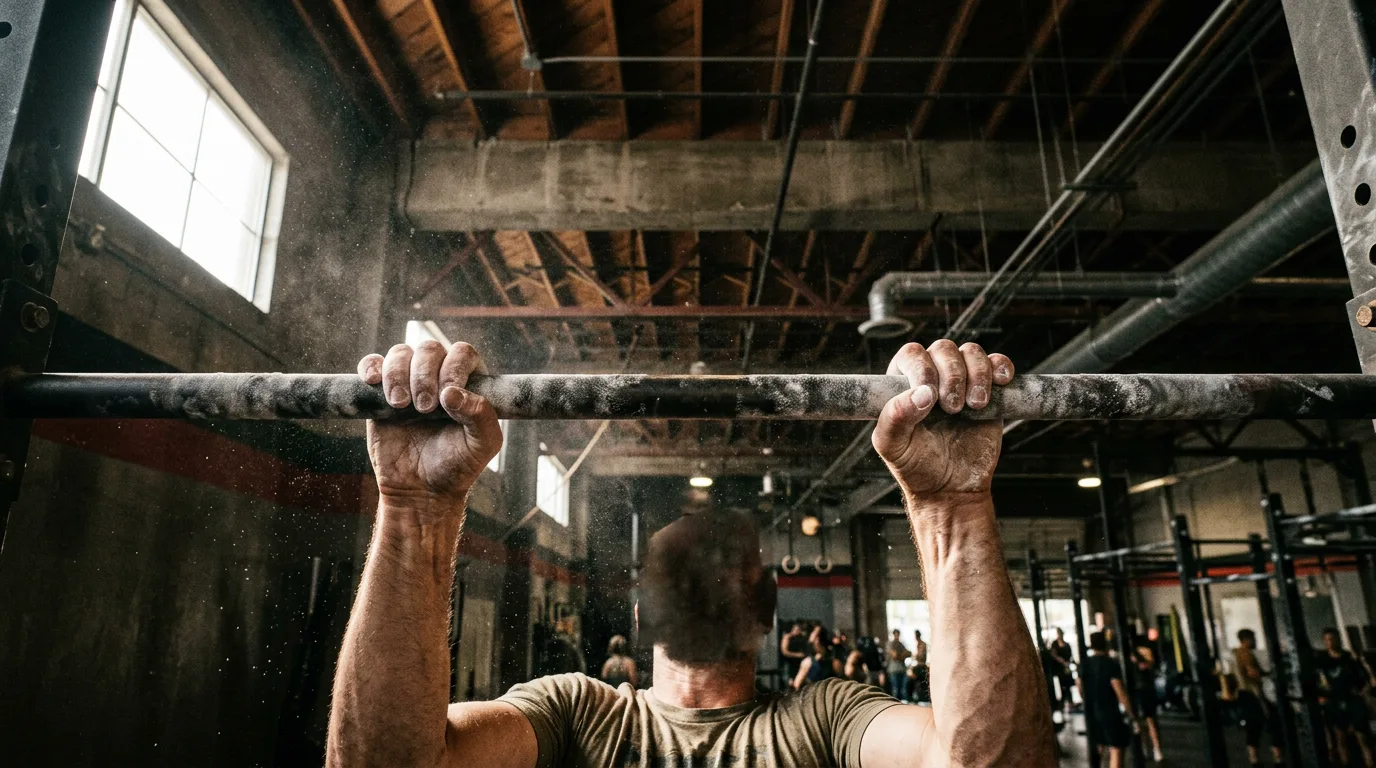
Why Pull-Ups Destroy Your Grip Faster Than Other Exercises
Three factors combine to make pull-up bars the fastest way to burn through your chalk:
First, sustained hanging time. A set of 10 strict pull-ups takes 20-30 seconds of uninterrupted bar contact. A set of 20 kipping pull-ups takes 30-45 seconds. During that entire window, your hands are clamped around the bar with no chance to rest, rewipe, or readjust. Sweat accumulates continuously with no break for the chalk to recover.
Second, rotational forces. Kipping and butterfly pull-ups swing your body in an arc, which means the bar is not just being gripped — it is being rotated against. Your hands do not slide off the bar vertically; they spin around the circumference as your body swings forward and back. This rotational shear is what tears calluses and strips chalk off your hands faster than static gripping.
Third, heat generation. Your flexor muscles run from your forearm through your wrist into your fingers. Sustained grip effort pumps blood into those muscles, which raises the temperature of your hands. Warmer hands sweat more. The pull-up is a self-defeating loop: the effort that demands grip also produces the sweat that destroys grip. Chalk breaks this loop by absorbing the sweat before it reaches the bar surface.
Grip Placement and Where to Focus Your Chalk
Most people grab the pull-up bar in the center of their palm and close their fingers around it. This is wrong, and it is the primary reason for both grip failure and callus tears. The bar should rest in the proximal finger crease — the fold line where your fingers meet your palm — not in the mid-palm.
When the bar sits in the finger crease, your fingers wrap around the bar with more contact area and less palm skin folded underneath. This reduces the skin bunching that causes calluses to build up and eventually rip. It also positions the bar where your finger flexors can apply maximum force.
Focus your chalk application on this contact zone: the four finger pads, the proximal crease, and the base of each finger. Add coverage to the thumb pad if you use a full-wrap grip (thumb around the bar) or the inside of the thumb for a false grip (thumb on top of the bar). A light coating on the mid-palm handles residual moisture, but the concentrated zones are where performance lives.
Pull-Up Variations and Their Chalk Demands
Strict Pull-Ups
Strict pull-ups have the simplest chalk requirement. The grip is static — your hands maintain position throughout the rep. The bar does not rotate against your skin because there is no swing. A standard fingertip-and-crease application lasts through 3-5 sets of 8-12 reps. Reapply only if your hands feel damp at the grip points, which typically happens 15-20 minutes into a session.
Kipping Pull-Ups
The kip introduces horizontal force. As your body swings forward (in the "arch" position), the bar presses into the base of your fingers. As you swing back (in the "hollow" position), the bar shifts toward your fingertips. This oscillation grinds chalk off your hands with every rep. For kipping sets, apply chalk heavier than you would for strict work, and extend coverage to the full finger length rather than just the pads and crease.
High-rep kipping sets (20-30 reps) in a CrossFit WOD are where grip fails first. Apply liquid chalk generously before the workout and accept that mid-set reapplication is not possible. If the WOD includes a transition between movements, use that gap for a 5-second touch-up application.
Butterfly Pull-Ups
Butterfly pull-ups generate even more rotational force than kipping because the hand path traces a circular loop rather than a pendulum swing. The bar stress is constant and multi-directional. Chalk degrades fastest during butterfly sets. Apply a full coat before starting, and consider a tackier formula (rosin-enhanced) if you regularly perform high-volume butterfly sets. The extra adhesion helps resist the multi-directional shear.
Weighted Pull-Ups
Adding weight via a dip belt or weighted vest increases the downward force on your grip without adding rotational stress. The chalk demand is similar to strict pull-ups but at higher intensity. Focus on the fingertips and crease — the extra load tries to peel the bar out of your grip from the bottom. A heavier chalk application on the finger pads provides the friction margin that prevents the bar from migrating toward your fingertips under the extra load.
Ring Pull-Ups and Muscle-Ups
Rings add an instability component. The rings rotate freely, which means your hands must grip AND stabilize simultaneously. Chalk both your hands and the ring surface — yes, chalk the inside of the ring where your fingers wrap. The smooth fiberglass or plastic ring surface is slick when wet, and chalking it provides grip on both sides of the friction equation.
For ring muscle-ups, the transition from below to above requires a rapid grip rotation. Chalk the full hand surface from fingertips to wrist, including the outer edge of the palm that contacts the ring during the transition. Any moisture in the transition zone stalls the movement — your hands rotate on the ring instead of the ring rotating in your hands.
Preventing Hand Tears During Pull-Ups
Hand tears (rips) are the most common pull-up injury, and they sideline athletes for days. The mechanism is consistent: a raised callus catches the bar during the downswing of a kipping motion, and the shear force peels the callus off, exposing raw skin underneath. Liquid chalk reduces tear frequency through two mechanisms.
First, the bonded chalk layer smooths the skin surface. Raised calluses have edges that catch on the bar. The chalk fills in around those edges, creating a more uniform surface that slides rather than catches. Second, the moisture absorption keeps the skin at an optimal hydration level. Wet skin is soft and tears easily. Excessively dry skin cracks and tears. Chalk maintains the middle ground — dry enough for friction, hydrated enough for elasticity.
But chalk alone is not enough. Callus management is the foundation of tear prevention:
- File calluses twice per week. Use a pumice stone, fine-grit sandpaper (220+ grit), or a callus shaver to keep calluses flush with the surrounding skin. A smooth, flat callus grips without catching.
- Moisturize after every session. Climbing balms (ClimbOn, Rhino Skin) or thick unscented hand cream restore the moisture that chalk and bar friction strip away. Apply after washing your hands post-workout.
- Adjust your grip. If you grip too deep in the palm, the skin folds and compresses, building thick calluses faster. Move the bar to the finger crease to reduce skin bunching.
Best Formulas for Pull-Up Performance
Pull-up chalk needs fast dry time (you are heading straight to the bar), strong adhesion under rotational force, and a moderate thickness that does not create a spongy barrier between your skin and the bar. These five products match those requirements.
1. Spider Chalk Black Widow — Best for High-Volume Bar Work
Grip-Lock Technology delivers 40-55 minutes of continuous grip, covering even the longest kipping or butterfly sets. The nano-resin bond resists the rotational shear that strip standard chalk off your hands. At mid-range for 4 oz, 588 reviews at 4.5 stars. Made in USA with skin-friendly ingredients that do not crack skin during daily bar work.
Read our full Spider Chalk Black Widow review | Check Price on Amazon
2. SPORTMEDIQ Pro Grade — Best for Gym Regulars
The 250ml pump bottle delivers rosin-enhanced formula in a convenient dispenser. The rosin adds tackiness that reduces the rotation of your hands around the bar during kipping movements. At premium for 250ml with 3765 reviews at 4.7 stars. The pump makes mid-session reapplication fast — one pump, rub, go.
Read our full SPORTMEDIQ review | Check Price on Amazon
3. PowerGrip 50ml — Best for Extended Sessions
The honey and rosin blend provides a secondary grip layer when the primary chalk starts to fade. For long bar sessions (90+ minutes mixing pull-ups, toes-to-bar, and muscle-up practice), that secondary grip extends effective coverage without reapplication. At budget-friendly for 50ml, 444 reviews at 4.6 stars. Grip duration of 35-50 minutes outperforms most competitors.
Read our full PowerGrip 50ml review | Check Price on Amazon
4. EVMT Brands — Best Quick-Dry Budget Option
The 10-15 second dry time gets you on the bar faster than any other formula. At affordably priced for 50ml, with 3121 reviews at 4.6 stars. The "Weightlifting" variant works across all bar surfaces. Grip duration of 25-35 minutes covers most training sessions. Buy the multi-pack for better per-bottle value.
Read our full EVMT Brands review | Check Price on Amazon
5. Medi Chalk — Best Starter Chalk
Dual bonding agents, carabiner clip, and a budget-friendly price make this the default recommendation for someone trying liquid chalk on pull-ups for the first time. Over 2609 reviews at 4.5 stars. Grip duration is shorter (15-25 minutes), but for a 30-minute pull-up session, one application covers the work.
Read our full Medi Chalk review | Check Price on Amazon
Common Pull-Up Chalk Mistakes
Four patterns consistently reduce grip performance on the pull-up bar:
- Gripping the bar in the mid-palm. The bar belongs in the finger crease, not the palm center. A palm-grip forces skin to fold under the bar, building calluses faster and reducing grip contact area. Chalk applied to a palm-grip is less effective because the primary contact zone is wrong.
- Chalking only the palm and ignoring the fingers. Your fingers are doing the actual gripping. The palm provides support. Focus chalk application on the finger pads and crease — 80% of your chalk should go there, with 20% on the palm for general coverage.
- Not waiting for the chalk to dry. Wet chalk on a pull-up bar creates a slippery paste. The alcohol needs 10-20 seconds to evaporate. If you grab the bar while the chalk is still wet, you will feel worse grip than no chalk at all. Wait for the white, dry finish before pulling.
- Over-chalking to compensate for bad calluses. If your calluses are raised and catching the bar, more chalk will not fix the problem. Shave the calluses down, then chalk normally. Thick chalk layers on rough calluses create a spongy barrier that reduces bar feel and still catches during the kip.
Pull-Up Bar Grip Questions
Does liquid chalk help with pull-up bar callus tears?
Should I use liquid chalk for strict pull-ups or only kipping?
How do I apply liquid chalk for muscle-ups specifically?
Will liquid chalk damage a home pull-up bar finish?
Can I use liquid chalk on a thick bar or fat grip attachment?
Is chalk necessary for band-assisted pull-ups?
Stay On the Bar
Every rep you lose to slipping hands is a rep your back and arms were ready to complete. Liquid chalk keeps you connected to the bar through strict sets, kipping rounds, and muscle-up transitions. The formula costs less per session than a cup of coffee and fits in any gym bag. Pick one, bring it to every workout, and finish the set.
Check Price on AmazonGet Our Top 3 Picks
Get our top 3 picks for your budget — one email, then only updates.
Only when something changes. Unsubscribe anytime.