Liquid Chalk for Powerlifting: Meet-Day and Training Guide
Powerlifting is three lifts, nine attempts, and zero margin for error. A grip failure on your third deadlift attempt does not care how strong your back is — the bar falls, the lift is gone, and the total stays the same. Liquid chalk gives you a bonded magnesium carbonate layer that stands up to the adrenaline sweat, the hot lights, and the extended waits between attempts that define competition day. This guide covers federation rules, warm-up room protocol, attempt-by-attempt strategy, and the specific formulas that competitive powerlifters trust at national and international meets.
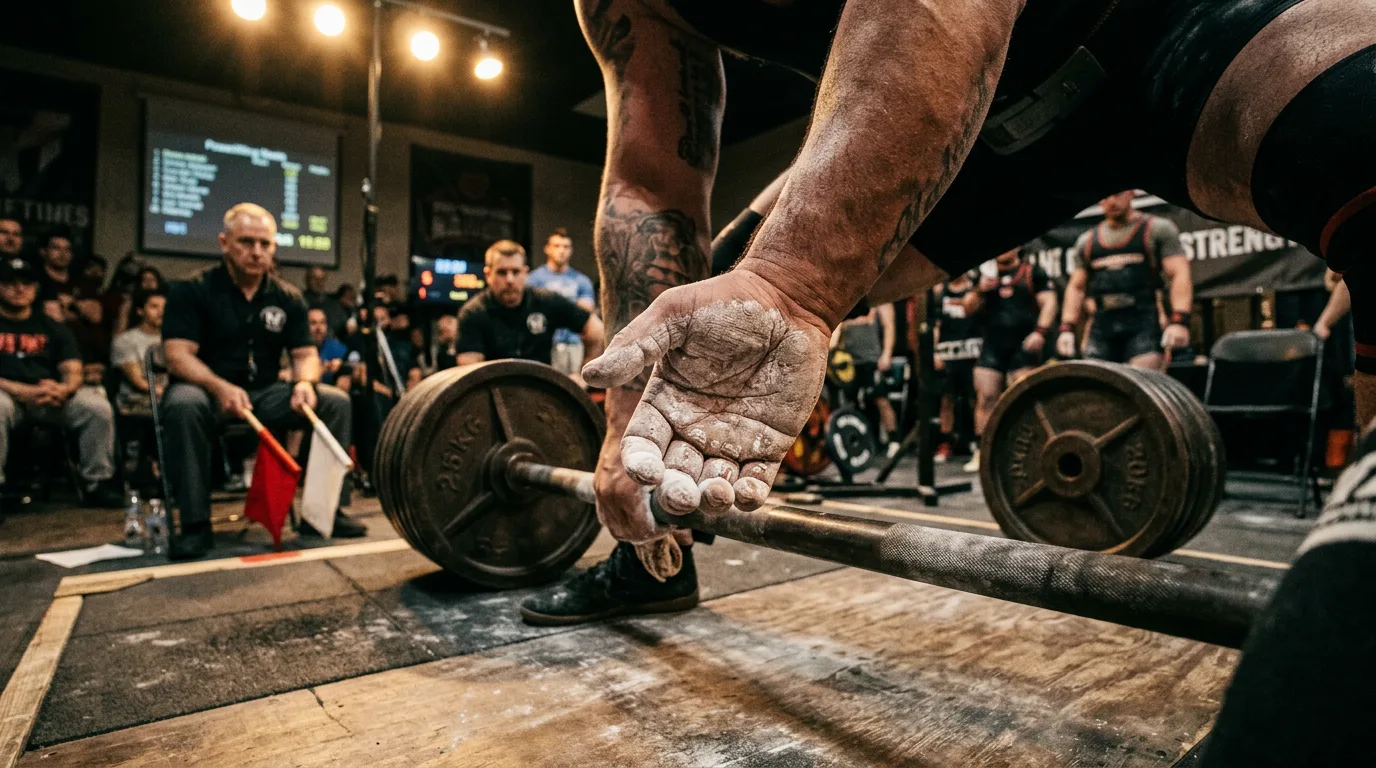
Why Competitive Powerlifters Prefer Liquid Over Powder
Walk into any USAPL or USPA warm-up room and you will see both formats. Chalk bowls with crumbled blocks sit on shared tables, and lifters dig in before every attempt. But an increasing number of competitors pull a small bottle from their belt bag instead. The reasons are practical, not trendy.
First, consistency. Powder chalk varies in coverage depending on how much you grab, how dry your hands are, and how aggressively you clap. Some applications are thick and cakey; others are barely there. Liquid chalk delivers the same bonded layer every time — squeeze, rub, wait, grip. The standardization matters when your third attempt is on the bar and you cannot afford to wonder whether your chalk job was good enough.
Second, duration. A single application of quality liquid chalk lasts 30-60 minutes depending on the formula. At a powerlifting meet, you might wait 15-20 minutes between attempts in a large flight. Powder chalk degrades during that wait — sweat seeps under the surface layer, and by the time you walk to the platform, your hands are damp underneath a flaky exterior. Liquid chalk bonds into the ridges of your skin and stays effective through the wait.
Third, the warm-up room environment. Shared chalk bowls are a hygiene concern — every lifter's sweat contributes to the communal powder. Your own bottle means your own clean chalk, applied fresh for each attempt. At national meets where 300+ lifters rotate through the same warm-up area over a full day, this is more than a preference.
The Three Lifts: Where Chalk Matters and Where It Matters Most
Grip is not equally important across all three powerlifts. Deadlift is where grip fails cost totals. Squat has a different kind of grip demand. Bench press is about traction, not hand friction. Understanding each lift's specific needs changes how you apply chalk and how much you use.
Deadlift — The Lift That Breaks Grips
Every powerlifter knows: the deadlift is where chalk earns its keep. The bar sits in your fingers — not your palm — and the entire load pulls straight down against your grip. Conventional or sumo stance does not change this fundamental demand. Your finger pads, the crease at the base of each finger, and the thumb (for hook grip) are the primary contact zones.
Apply liquid chalk with deliberate attention to those finger contact points. A nickel-sized amount per hand, worked into the pads of each finger and the first joint crease. For hook grip, coat the thumb pad and the inside of the index and middle fingers where they wrap over the thumb. Let the alcohol fully evaporate — a minimum of 15 seconds, longer in humid venues — before touching the bar.
For mixed grip deadlifters, the supinated hand (underhand) needs heavier coverage. That palm faces upward during the pull, which means sweat pools on the gripping surface instead of dripping off. Apply a second thin pass to the underhand side. The overhand grip follows standard finger-pad coverage.
Squat — Bar Security, Not Hand Grip
Squats do not fail because the bar slips from your fingers. They fail because the bar shifts on your back, your wrist angle collapses, or your hands lose the active pull that keeps low-bar position locked. Chalk serves a stabilization role here, not a gripping role.
For low-bar squats, chalk both palms and the full finger length. Your hands pull the bar into your rear deltoid shelf, and any moisture between your palms and the knurling allows the bar to creep upward during the set. For high-bar squats, the demand is lower — the bar sits on the traps with less hand involvement — but chalked palms still prevent the subtle wrist shifts that cause elbow pain over time.
The advanced technique: chalk your upper back and rear delts where the bar contacts your body. Apply a thin swipe across the shelf area before putting on your singlet or shirt. The chalk creates traction between the bar and your skin (or fabric), preventing the bar from sliding during the eccentric phase. This is standard practice among competitive squatters who handle 250+ kilograms.
Bench Press — Back Traction Over Hand Friction
The bench press grip demand is on the heel of your palm, where the bar locks into pressing position. Chalk this area to prevent the bar from rolling toward your fingers under load, which forces the wrist into painful extension. But the bigger advantage of chalk on bench press is not on your hands at all.
Your upper back slides on the bench surface during leg drive. The combination of sweat and vinyl creates a frictionless surface that bleeds power from your drive phase. Chalk your traps, upper back, and the backs of your shoulders before lying down. The difference is immediate — you will feel the bench grab your back, and every newton of leg drive transfers into the bar instead of sliding you up the bench.
Meet-Day Protocol: Attempt-by-Attempt Chalk Strategy
A full powerlifting meet involves 9 attempts across three lifts, typically spanning 4-8 hours depending on flight size. Your chalk strategy should match the timing and intensity of each phase.
Squat Flight
Attempts: 3 (opener, second, third)
Timing: 10-20 min between attempts
Strategy: Apply once before your opener. The bonded layer lasts through all three squat attempts for most lifters. If the venue is hot and you are sweating through your singlet, a quick refresh before your third attempt is reasonable.
Bench Flight
Attempts: 3 (opener, second, third)
Timing: 10-20 min between attempts
Strategy: Fresh application before your bench opener — different grip contact points than squats. Focus on the palm heel and the upper back traction zone. One application covers all three bench attempts unless the bench surface is particularly slick.
Deadlift Flight
Attempts: 3 (opener, second, third)
Timing: 10-20 min between attempts
Strategy: Fresh application before deadlifts — this is where grip is truly tested. Consider the hybrid approach: liquid chalk base plus a powder chalk top coat from the communal bowl right before each attempt. The liquid base handles moisture; the powder adds immediate dry friction.
Training vs Competition: Different Chalk Approaches
Training and competition present different demands, and your chalk strategy should reflect that. In training, you want to build grip strength alongside your lifts. In competition, you want to eliminate every possible variable.
During regular training sessions, use chalk only for working sets — not warm-ups. Pulling your warm-up sets with bare hands forces your grip to develop alongside your deadlift. When the weights get heavy enough that grip becomes the limiting factor, chalk up. This builds a reserve of grip strength that pays dividends on meet day when your hands are fully chalked and the bar feels like it is glued to your fingers.
During peaking blocks (the 4-6 weeks before a competition), switch to meet-day chalk protocol for every heavy session. Apply the same way you will on the platform, with the same product, at the same timing. This is rehearsal — you want zero surprises when the lights turn on. If you plan to use a liquid chalk base plus powder top coat at the meet, practice that exact combination during your peaking sessions.
Some coaches recommend alternating: one heavy session per week with chalk, one without. The uncharged session builds raw grip endurance; the chalked session lets you handle true maximal loads without grip being the limiting factor. Both adaptations are valuable for a competitive powerlifter.
Recommended Formulas for Powerlifters
Powerlifting favors formulas that bond hard, last long, and are competition-legal. After evaluating 19 products against the specific demands of the squat, bench, and deadlift, these five earned spots in a serious lifter's kit.
1. Spider Chalk White Widow — Best for Competition Use
White Widow's nano-resin formula delivers up to 60 minutes of continuous grip — long enough to handle an entire flight of deadlift attempts without reapplication. The extra-thick paste takes 25-30 seconds to dry, but once set, it stays bonded through heavy pulls, chalk bowl layering, and the nervous sweating that comes with a 3rd-attempt PR. USAW and USAPL sanctioned for competition.
At premium for 8 oz, this is positioned at the higher end of the market. But the 400+ applications per bottle and competition approval make it the default choice for lifters who treat meets seriously. With 90 reviews at 4.5 stars, the formula has proven itself on platforms across the country.
Read our full Spider Chalk White Widow review | Check Price on Amazon
2. SPORTMEDIQ Pro Grade — Best for Daily Training Volume
The 250ml pump bottle is purpose-built for high-frequency training. The rosin-enhanced formula creates a tackier grip surface than pure magnesium carbonate, which translates to better bar security on heavy singles and triples. The pump dispenser means one-handed application between sets — no fumbling with bottle caps while your training partner is waiting.
Over 3765 Amazon reviews at 4.7 stars make this one of the most validated training chalks available. At premium for 250ml, the cost per application is minimal. For lifters who train 4-6 days per week and chalk up for every heavy session, the large-bottle economy is hard to beat.
Read our full SPORTMEDIQ review | Check Price on Amazon
3. WARM BODY COLD MIND — Best Pure Magnesium Carbonate Formula
Designed by Olympic champion Oleksiy Torokhtiy, this twin-pack delivers 100% pure magnesium carbonate with zero additives. The clean formula appeals to powerlifters who want the bar to move freely without the extra tackiness that rosin-enhanced products add. For lifters who alternate between powerlifting and Olympic work, this formula bridges both disciplines without the sticky residue.
The twin 50ml format fits the meet-day use case: one bottle in your warm-up bag, one in your belt bag on the platform. At mid-range for the pair, the per-bottle cost reflects the athlete endorsement and dual-packaging. Over 1071 reviews at 4.6 stars confirm the formula works.
Read our full WARM BODY COLD MIND review | Check Price on Amazon
4. Liquid Grip — Best for Heavy Sweaters
Liquid Grip's water-based formula with USP-grade rosin is specifically engineered for high-moisture environments. If your hands start sweating during the walk-out on squats and are dripping by the time you set up for deadlifts, this product handles that level of moisture better than alcohol-based competitors. The water base means no harsh alcohol sting on cracked calluses — a real advantage during heavy training blocks when your hands are beat up.
The premium price for the 8 oz bottle is competitive in the large-bottle category. With 641 reviews at 4.7 stars, this formula has been around long enough to prove its consistency. The rosin provides a secondary tacky layer when the magnesium carbonate starts to wear, extending effective grip time.
Read our full Liquid Grip review | Check Price on Amazon
5. IRON AMERICAN Combo Kit — Best Dual Training/Meet Setup
The combo kit solves the logistics problem: an 8.3 oz bottle for your home gym or training facility, and a 1.7 oz travel bottle with carabiner for your meet bag. The lifetime warranty from a USA-based company adds confidence. For lifters who train at home during the week and compete at different venues throughout the year, having purpose-matched bottles for each context simplifies preparation.
At top-tier for both bottles, the combo pricing undercuts buying separate training and competition chalks. Grip quality is solid for all three lifts, though some users have noted batch-to-batch variation in thickness. The carabiner on the travel bottle clips directly to a lifting belt or singlet strap for platform-side access.
Read our full IRON AMERICAN review | Check Price on Amazon
Hand Care Between Training Sessions
Powerlifting training tears up your hands. Heavy deadlifts shear calluses, aggressive knurling abrades skin, and repeated chalk application draws moisture from your palms. Without a hand care routine, the skin cracks, calluses tear, and you end up training with bandaged hands that grip worse than healthy ones.
After each training session, wash your hands with mild soap to remove chalk residue. Aggressive scrubbing is unnecessary — the chalk dissolves with water and light friction. Once clean, apply a thick, unscented hand cream or a climbing-specific balm like Rhino Skin or ClimbOn. These products rehydrate the skin without leaving an oily film that would compromise grip at your next session.
Callus management is separate from chalk usage but related. Use a pumice stone or a callus shaver once per week to keep calluses flat and smooth. Raised, rough calluses catch on knurling and tear — creating open wounds that force you to skip pulling sessions entirely. A smooth, thick callus is the goal: enough protection to handle knurling without protruding enough to catch. Liquid chalk actually helps maintain calluses because the thin, bonded layer reduces the shearing force between your skin and the bar compared to bare-hand or powder-only pulling.
Mistakes That Cost Lifters Attempts
After observing hundreds of lifters at meets and training sessions, these four patterns consistently lead to grip problems that are blamed on the chalk rather than the technique:
- Chalking warm-ups but not building grip. Using chalk from your first empty-bar warm-up set robs your hands of the training stimulus that builds grip strength. Save chalk for working sets. Your warm-up grip should be trained raw.
- Ignoring the back on bench press. Powerlifters obsess over hand chalk for deadlifts and forget that bench press performance depends on upper-back traction. Chalk your traps and rear delts — the performance difference is immediate.
- One-size-fits-all application. Deadlift chalk goes on the finger pads. Squat chalk goes on the full palm. Bench chalk goes on the palm heel and back. Each lift has different contact zones. Applying the same generic full-hand coat for all three wastes product and leaves the high-demand areas under-covered.
- Waiting until grip fails to start chalking. By the time the bar slips from your hands, your skin is saturated with sweat. Chalk applied to wet skin creates a slurry instead of a bonded layer. Apply before your hands are wet — the chalk bonds to dry skin and then resists the moisture that follows.
Powerlifter Chalk Questions
Is liquid chalk legal in USAPL and USPA competitions?
How do I prevent liquid chalk from drying out my hands during a long meet?
Should I use liquid chalk or powder chalk for deadlift attempts at a meet?
Does liquid chalk work with a sumo deadlift stance as well as conventional?
Can liquid chalk replace wrist wraps or a lifting belt?
How much liquid chalk should I bring to a powerlifting meet?
Own the Platform
Every kilogram on your total is earned through months of training. Do not let a sweaty grip steal what your muscles already have the strength to lift. Liquid chalk removes the variable, gives you consistent grip from opener to third attempt, and fits in the belt bag you are already carrying. Pick the formula that matches your competition and training demands, and stop worrying about whether your hands will hold.
Check Price on AmazonGet Our Top 3 Picks
Get our top 3 picks for your budget — one email, then only updates.
Only when something changes. Unsubscribe anytime.