Liquid Chalk for Handstands: Wrist Stability and Balance Control
Handstand balance lives in your fingertips. Micro-adjustments of finger pressure against the floor — measured in grams of force shifting between index finger, pinky, and thumb mound — are what keep an inverted body stable over a single point of contact. When sweat compromises the friction between your palms and the floor surface, those micro-adjustments lose precision. Your fingers press harder but the force slides instead of transferring. Liquid chalk restores the friction interface that makes balance corrections effective, extending practice time and improving the quality of every hold. This guide covers the biomechanics of handstand grip, surface-specific strategies, application technique for balance work, and which formulas suit the sustained palm contact that handstand training demands.
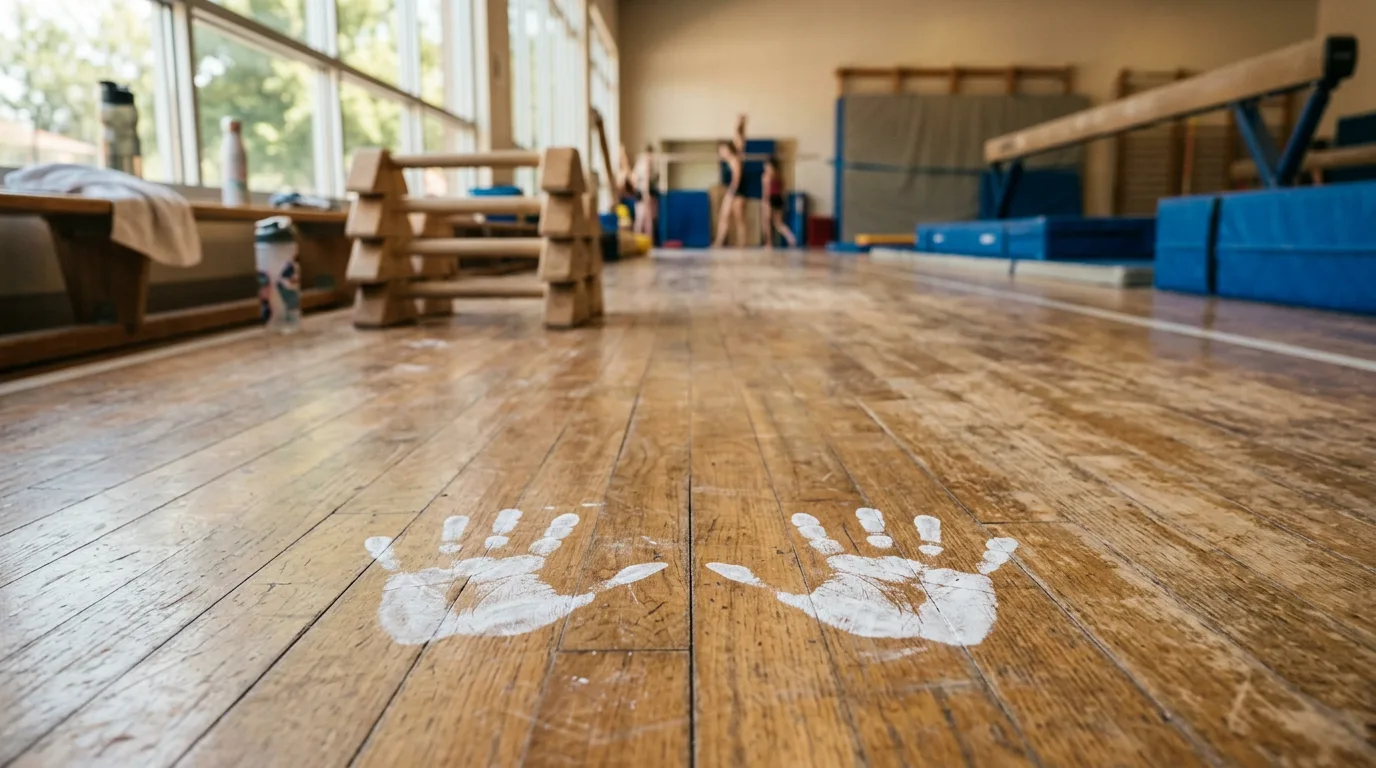
How Handstand Balance Actually Works at the Palm
Stand on your feet and sway forward — your toes press down to pull you back. Sway backward — your heels press to recover. Now invert that. In a handstand, your fingertips act as the "toes" (front of the base) and the heel of your palm acts as the "heel" (back of the base). Balance corrections happen through pressure redistribution across this palm surface, dozens of times per second in a freestanding hold.
Over-balance (falling toward the back of your hands) triggers increased fingertip pressure. Under-balance (falling toward your knuckles/the direction you are facing) triggers increased heel-of-palm pressure. Side-to-side corrections distribute pressure between the pinky side and thumb side of the hand. Each of these pressure transfers requires friction. If your fingertips are sweaty and pressing hard but sliding, the correction force does not reach the floor — and you fall.
This is fundamentally different from how chalk works in lifting or climbing. In those sports, chalk prevents an implement from leaving your hand. In handstands, chalk allows pressure information to transfer between your palm and the ground surface. It is a feedback mechanism as much as a friction mechanism. Experienced handbalancers describe the difference as "feeling" the floor through the chalk — thin, bonded liquid chalk preserves this tactile sensitivity better than thick block chalk that dampens the feedback.
Surface-by-Surface Strategy
Handstand practitioners train on a wider variety of surfaces than most athletes. Your chalk strategy should adjust based on what is under your hands.
Hardwood Floor
The gold standard surface for handstand training. Smooth but not slippery, hardwood provides excellent tactile feedback. A thin liquid chalk application handles moisture management without over-gripping. The wood grain provides micro-texture that supplements chalk friction. One coat lasts through a 30-40 minute practice session. Avoid waxed or freshly polished hardwood — the wax layer reduces chalk adhesion to the floor surface.
Rubber Gym Flooring
Rubber tiles and rolled rubber flooring have built-in texture that provides high natural grip. Chalk improves consistency — rubber grip changes with temperature and humidity, but chalk creates a stable friction layer regardless of ambient conditions. Light application. The rubber does not absorb chalk, so residue sits on the surface — wipe your practice area after training to avoid slippery chalk buildup for the next user.
Concrete / Outdoors
Rough concrete provides aggressive grip naturally. Minimal chalk needed — the surface does most of the friction work. The issue outdoors is moisture: morning dew, recent rain, or humid air deposits water on the concrete that creates a slippery film. Chalk on your hands repels this surface moisture from the contact zone. For rough concrete, chalk also protects against abrasion — the bonded layer reduces skin scraping without reducing grip.
Yoga Mat / Soft Surface
Yoga mats compress under hand pressure, creating an unstable base that makes handstands harder. The surface texture varies — natural rubber mats are grippy, PVC mats are often slippery, TPE mats fall in between. On slippery mats, chalk makes a large difference. On grippy rubber mats, chalk provides moisture management. For serious handstand practice, train on a hard surface when possible and use a mat only for padding during falls.
Freestanding Handstand: Maximum Balance Demand
The freestanding handstand is the most chalk-sensitive balance skill. There is no wall to catch you, no spotter to stabilize you, and no external support. Every correction comes from your hands pressing against the floor. The duration of your hold depends partly on strength, partly on technique, and partly on whether your hands can transmit correction forces without slipping.
During a 30-second freestanding hold, your palms generate measurable sweat from the isometric effort and the stress of being inverted. Blood pools in your hands due to gravity. This combination of moisture and vascular pressure makes the palm surface progressively slipperier throughout the hold. Liquid chalk's bonded layer handles this progressive moisture better than block chalk, which begins dissolving immediately on contact with sweat.
For practitioners working toward their first 30-second or 60-second freestanding hold, chalk can be the difference between consistent 20-second holds and consistent 30-second holds. The chalk does not improve your balance skill — it prevents moisture from truncating holds that your balance ability can sustain. This distinction matters for training: if your max hold is 15 seconds without chalk and 25 seconds with it, the limiting factor at 15 seconds is moisture, not balance. Train with chalk to develop balance skill, then test without chalk to see your raw capacity.
Press Handstands and Dynamic Entries
Press handstands — lifting from a standing forward fold into a handstand through strength rather than kicking — place sustained, progressive load on the hands throughout the press. The entry takes 3-8 seconds depending on tempo and control, and your palms bear an increasing percentage of your bodyweight as your hips travel over your shoulders. Friction demand increases with load, making the final portion of the press (when you are almost inverted and nearly at full bodyweight) the most friction-critical moment.
A hand slip during a press entry is more dangerous than during a freestanding hold because your bodyweight is in motion. A slip at 80% of the press means your body collapses from an awkward angle with significant momentum. Chalk turns this from a risk into a non-issue — the bonded friction layer holds through the progressive loading that the press demands.
For straddle press, the hands are wider than shoulder width. For pike press, the hands are shoulder width or narrower. The wider straddle position spreads your weight across more floor surface per hand, reducing friction demand per square centimeter. Pike press concentrates the load on a smaller hand base, requiring more friction. If you are training pike press specifically, apply a slightly heavier chalk coat than for straddle press.
Handstand Walking: Mobile Grip
Handstand walking adds a dimension that static holds do not: your hands must release, relocate, and re-grip the floor in rapid sequence. Each hand lift and re-plant involves a brief loss of friction contact. The remaining hand bears full bodyweight for a fraction of a second. Then the walking hand contacts a new floor position where chalk residue from previous contacts may or may not exist.
Liquid chalk handles handstand walking better than block chalk because the bonded layer travels with your hands. Block chalk deposits on the floor, reducing your hand's chalk layer with each step. After 20-30 walking steps with block chalk, your hands have deposited most of their chalk onto the floor — leaving your palms under-chalked and the floor with white handprints. Liquid chalk's bonded film retains more material on the hand through repeated contacts.
For handstand walk practice over significant distances (gym floor crossings, outdoor handstand walks), apply chalk before the first attempt and reapply every 3-4 minutes or after every 50-60 feet of walking. The reapplication frequency depends on floor texture — rough concrete strips chalk faster than smooth hardwood because the abrasive surface scrubs the layer with each hand plant.
One-Arm Handstand: When Friction Is Everything
The one-arm handstand concentrates your entire bodyweight onto a single palm. Every correction that normally distributes across two hands — 10 fingers, 2 palm heels, 2 thumb mounds — now routes through 5 fingers and 1 palm. The balance demand is exponentially higher, and the friction demand per unit of hand area doubles compared to a two-arm hold.
For one-arm handstand practitioners, chalk is not optional. The combination of extreme load concentration and extended hold duration (most one-arm handstand training involves 5-15 second attempts, repeated many times) means your palm generates significant sweat under the sustained compression. Without chalk, most practitioners report losing grip within 5-8 seconds regardless of balance ability. With a solid liquid chalk application, holds extend to the actual balance limit rather than the friction limit.
Application for one-arm work: apply to both hands (you will likely train both sides). Focus extra coverage on the middle three fingers and the center of the palm — these are the primary load-bearing zones in a one-arm hold. The pinky and thumb become more important for side-to-side corrections, so chalk them thoroughly as well. The one-arm handstand is the single hand balance skill where complete, even chalk coverage matters most.
Recommended Formulas for Handstand Practice
Handstand training needs a formula that applies thin (for tactile sensitivity), dries fast (for frequent reapplication during practice), and bonds well (for holds lasting 30+ seconds). These picks match those requirements for different practice environments and training styles.
EVMT Brands Liquid Chalk — Best for Indoor Practice
Quick-drying, thin-application formula that preserves the floor sensitivity handstand practice demands. The fast evaporation suits the frequent reapplication rhythm of balance training — apply, practice 2-3 attempts, reapply. At affordably priced, the compact bottle fits in a gym bag or sits beside your practice area without taking up space.
Check Price on AmazonSpider Chalk Black Widow 4oz — Best for Outdoor Training
The dark-tinted formula does not leave visible white handprints on concrete, sidewalks, or public park surfaces — important for outdoor handstand practitioners who train in shared spaces. Strong MgCO3 concentration handles the humidity and ground moisture of outdoor surfaces. At mid-range, it provides durable grip for the variable conditions of outdoor practice.
Check Price on AmazonMedi Chalk Liquid Chalk — Best for Daily Practice
Handstand practitioners train daily — 15-45 minutes of balance work, every day. The cumulative chalk exposure adds up. This gentle formula at budget-friendly provides grip without aggressive skin drying, preserving the palm sensitivity that experienced handbalancers depend on for balance feedback. The thin application does not build up between sessions.
Check Price on AmazonWARM BODY COLD MIND Liquid Chalk — Best for Sensitive Hands
Skin-conditioning additives protect against the drying effect of daily chalk use. Handstand practitioners rely on palm sensitivity more than any other athlete — cracked, dried-out skin reduces the tactile feedback needed for balance corrections. At mid-range, this formula maintains skin health through months of daily practice while providing consistent grip quality.
Check Price on AmazonPowerGrip 50ml Travel Liquid Chalk — Best Pocket Size for Park Practice
Small bottle at budget-friendly that fits in a pocket or clip onto a belt loop for outdoor handstand sessions. When your practice spot is a park, a sidewalk, or a beach boardwalk, carrying a full-size bottle is impractical. This compact format provides enough chalk for a 30-45 minute outdoor session with 3-4 applications.
Check Price on AmazonApplication Technique for Handstand Training
Handstand chalk application differs from lifting application in one key way: you need complete, even coverage with a THIN layer. Thick chalk reduces the tactile sensitivity that handbalancers rely on for balance corrections. The goal is not maximum grip — it is consistent, reliable friction that lets you feel the floor.
Squeeze a small amount — less than you would for lifting — onto one palm. Spread between both hands, covering the full palm surface including heel of palm, finger pads, and thumb mound. Work the chalk into the skin rather than building it up on top. When the alcohol evaporates, you should see a barely-visible white film, not a thick white coating. If you can see defined chalk lines in your palm creases, you have applied too much.
Reapplication timing for handstand practice: every 10-15 minutes or when you notice moisture building between attempts. Unlike lifting where you chalk up before a specific heavy set, handstand practice is continuous — you attempt, rest 15-30 seconds, attempt again. The chalk degrades gradually rather than in bursts. A fresh thin coat every 10-15 minutes maintains consistent friction throughout a 30-60 minute practice session.
Errors That Cost You Hold Time
Over-chalking. Thick chalk creates a sliding layer between your hand and the floor. Handstand balance needs thin, bonded chalk — not a thick powder coat. If your practice spot has white handprints on the floor, you are using too much. The chalk should stay on your hands, not transfer to the ground.
Not chalking the heel of the palm. Under-balance corrections (when you start falling back toward your starting position) push through the heel of the palm. If only your fingertips are chalked, you have grip for over-balance corrections but not under-balance. Cover the full hand — both correction directions need friction.
Chalking on a wet surface. If the floor has moisture (condensation, spilled water, outdoor dew), chalk on your hands contacts water on the floor and dissolves instantly. Dry the practice area first. A gym towel wiped over your handstand spot takes 5 seconds and prevents the chalk-dissolving contact.
Training only with chalk and never without. Your raw balance ability may be better than you think — or worse. Occasionally practice without chalk (on a grippy surface) to understand your actual balance limit versus your friction limit. If your hold time drops from 30 seconds to 10 seconds without chalk, moisture is a major factor. If it only drops to 25 seconds, balance is your primary limiter and chalk is supplementary.
Blaming balance when the problem is grip. When your hands slide forward in a handstand, it looks like an over-balance problem. But the slide might be friction failure, not a balance error — your corrections were correct but did not transfer because the palm slipped. If you are falling forward repeatedly despite pressing hard with your fingertips, the issue is likely friction, not technique. Chalk up and test whether the falls stop.
Handstand Chalk: Practitioner Questions
Does liquid chalk work on yoga mats for handstands?
Yes, but with a caveat. Liquid chalk on your palms improves grip on most yoga mat surfaces — TPE, rubber, and PVC all benefit from the friction increase. The chalk does not damage mat materials. On porous surfaces like natural rubber, a thin application works best because thick chalk can fill the mat texture and reduce its natural grip. On smooth PVC mats, chalk makes a dramatic difference — transforming a slippery surface into a stable platform for handstand practice.
Should I chalk my whole hand or just fingertips for handstands?
Chalk the entire palm surface, finger pads, and the heel of the hand. Handstand balance corrections happen through finger pressure changes (fingertips push to prevent over-balance, heel of palm pushes to prevent under-balance). Both contact zones need friction to transmit force to the floor. Missing either zone means you lose balance correction ability in one direction. Full-hand coverage is mandatory for effective handstand balance.
How does surface type affect handstand chalk needs?
Hardwood floors and gymnastics mats provide natural texture that helps grip. A light chalk coat adds moisture management without over-gripping. Smooth concrete, polished tile, and lacquered gym floors are slippery — use a full chalk application or double-coat. Outdoor surfaces like grass and packed dirt provide good grip naturally but introduce moisture from the ground, making chalk useful for dew or damp conditions. Rubber gym flooring has built-in texture and needs minimal chalk.
Can too much chalk hurt handstand balance?
Yes. Over-chalking creates a powdery layer that slides on the floor surface instead of gripping it. Your hand sticks to the chalk layer, but the chalk layer slides on the floor — creating a false sense of security followed by sudden slip. Apply thin, let dry completely, and if the floor surface looks white with chalk, you have used too much. A properly applied liquid chalk coat is invisible on the floor after you step away — it stays on your hands, not on the ground.
Is liquid chalk better than gymnastic chalk blocks for handstands?
For handstands specifically, liquid chalk has two advantages: even coverage and no dust. Handstand balance depends on pressure across the entire palm surface — uneven chalk from blocks leaves dead spots that reduce feedback sensitivity. The thin, bonded liquid chalk layer lets you feel the floor through the chalk, which is the tactile feedback that handbalancers rely on for micro-adjustments. Block chalk is thicker and reduces this sensitivity.
Do handstand canes or parallettes need chalk?
Wooden parallettes and canes absorb sweat and provide natural grip through the wood grain — chalk is less necessary but still helpful during long practice sessions. Metal parallettes and canes with smooth or powder-coated handles need chalk. The contact area is small (just the width of the cane top), so friction per square centimeter must be high. Apply chalk to palms and let the grip handles stay clean — your chalked hand creates the friction, not the implement surface.
Stay Inverted Longer
When your balance ability outpaces your palm friction, chalk is the unlock. Thin, even coverage keeps corrections transferring to the floor through every second of your hold. Start with our top pick for handstand training.
Check Price on AmazonGet Our Top 3 Picks
Get our top 3 picks for your budget — one email, then only updates.
Only when something changes. Unsubscribe anytime.