Liquid Chalk for Grip Training: Crush, Pinch, and Support Grip
Grip training isolates the one variable that liquid chalk directly affects — the friction interface between your hand and a resistance implement. In every other sport, chalk is supplementary to the primary movement. In grip sport, chalk IS the equipment decision that determines your contact surface quality. Crush grippers, pinch blocks, hub lifts, thick bars, and support holds all respond differently to chalk based on implement surface texture, contact area, and hold duration. This guide breaks down the chalk strategy for each grip type, the debate around chalked versus raw training, competition rules, and which formulas handle the unique demands of dedicated grip athletes.
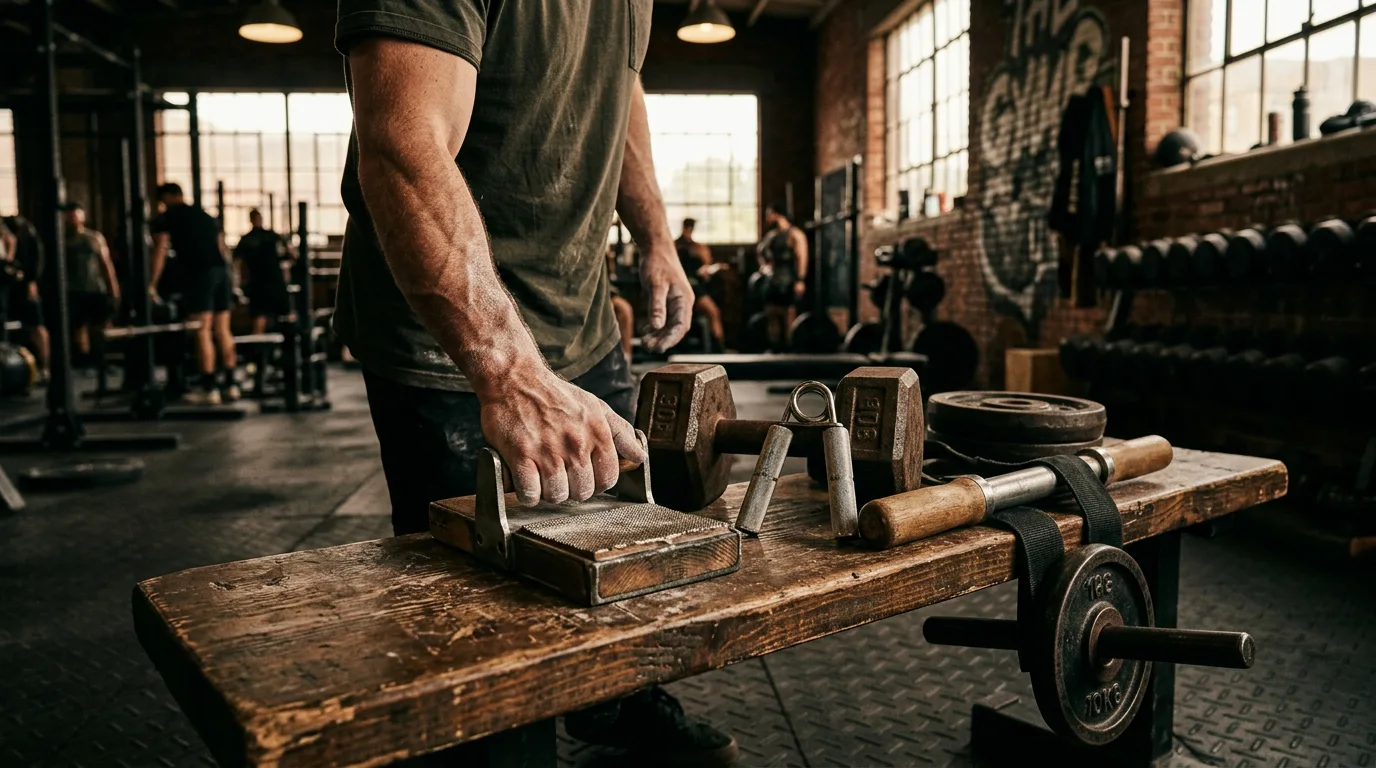
Grip Types and How Chalk Affects Each One
Grip strength is not one ability — it is at least four distinct capacities that use different hand structures and respond to chalk differently. Understanding this distinction prevents wasted chalk and guides application strategy.
Crush Grip
Crush grip is closing your hand against resistance — the classic gripper close. When you squeeze a Captains of Crush or equivalent gripper, the contact points are the finger pads, the thumb pad, and the heel of the palm. The handle surface is typically knurled aluminum or steel with a defined texture pattern.
Chalk on crush grip implements fills the skin micro-texture gaps that sweat normally occupies. On a knurled gripper handle, liquid chalk increases the effective friction coefficient by preventing moisture from lubricating the metal-to-skin interface. The effect is most noticeable on heavy attempts where your hand produces more sweat under the neural strain of near-maximal effort. A dry-skinned lifter in a cool gym sees less benefit than a heavy sweater in a hot facility — but both see measurable improvement on near-max attempts.
Application for crush grip: coat the full palm and all four finger pads. Pay extra attention to the thumb pad — on grippers with parallel handles, the thumb wraps around and provides counter-pressure. A chalked thumb pad prevents rotational slip that makes the gripper feel harder than it is. Let dry completely before picking up the implement.
Pinch Grip
Pinch grip isolates the thumb against the four fingers — no palm wrap, no finger curl. Pinch blocks, plate pinches, and hub lifts all test this capacity. The contact area is small: thumb pad and fingertip pads only. On smooth implements like Olympic plate hubs, friction is almost entirely chemical (from chalk) rather than mechanical (from surface texture).
This is where liquid chalk makes the largest absolute difference. A smooth 45-pound plate hub with zero chalk is nearly impossible to lift for most grip athletes. The same plate hub with a well-applied chalk coat becomes liftable. The chalk transforms a frictionless surface into a workable one. Every serious grip athlete chalks for pinch work — the question is not whether to chalk but how to apply it optimally.
Application for pinch grip: heavy coat on thumb pad and the first two phalanges of all four fingers. The contact zone is small but the friction demand per square centimeter is enormous. Double-coating (apply, dry, apply again) builds a thicker friction layer on smooth pinch implements. On textured pinch blocks with machined grip patterns, a single coat is sufficient.
Support Grip
Support grip is holding a weight with fingers wrapped around a handle — deadlift holds, farmer's walks, bar hangs. The hand wraps fully around the implement and friction occurs across the entire palm and finger surface. Support grip hold duration depends on both muscular endurance and friction maintenance over time.
Liquid chalk excels at support grip because the bonded layer persists through extended holds. A 60-second timed deadlift hold generates substantial palm sweat. Loose chalk applied at the start degrades through the hold as sweat dissolves the chalk layer. Liquid chalk's bonded film resists this degradation — the magnesium carbonate stays adhered to the skin rather than dissolving into the sweat and falling off as paste.
Application for support grip: full palm and finger coverage with emphasis on the finger hooks where the bar sits. For thick bar support holds (axle bar, fat grip attachments), chalk the finger pads heavily — the reduced wrap angle means less mechanical grip and more reliance on friction.
Wrist and Finger Extension
Extension grip — opening the hand against resistance using rubber bands, rice bucket training, or reverse gripper protocols — does not involve holding an implement. Chalk has no meaningful effect on extension work because there is no friction interface to enhance. Skip the chalk for extension training. Save it for the closing and holding movements where contact surface matters.
The Raw vs Chalked Training Debate
In the grip sport community, a long-standing debate exists: should you train raw (no chalk) to build friction-independent strength, or should you train chalked to practice under competition conditions? The answer — like most training questions — depends on your goals and your training phase.
Raw training forces your nervous system to recruit maximum grip force without the friction safety net. If you can close a gripper or hold a weight without chalk, you will find it easier with chalk. This overload effect builds raw hand strength that transfers to real-world situations where chalk is not available. Construction workers, firefighters, and military personnel benefit from raw grip training because their work environments do not allow chalk application.
Chalked training lets you handle heavier loads and practice at competition-level intensity. If your competition allows chalk, training without it means you never practice the exact feel and weight of competition attempts. A gripper that requires a specific set position under chalk feels different from the same gripper attempted raw. Competition preparation demands competition conditions.
Implement-Specific Chalk Strategies
Captains of Crush Grippers
Knurled aluminum handles. Chalk fills the knurling valleys for consistent friction. Set the gripper deep in the hand — the chalk prevents the handle from shifting during the set, which is a critical advantage for certified competition closes where the gripper must close from a specific starting position without readjustment.
Rolling Thunder
Smooth rotating handle. The handle spins under load, making friction the sole grip factor. Chalk is mandatory for serious Rolling Thunder work. Apply heavily to the entire palm and fingers. The rotating handle neutralizes finger curl — you cannot squeeze harder to compensate for friction loss. Every pound on the Rolling Thunder is a friction test.
Blob (York 50 Half)
Cast iron with a smooth, rounded surface. Pure pinch grip with zero mechanical texture. Chalk transforms this implement from impossible to challenging. Double-coat your thumb and fingers. The smooth cast iron surface means chalk-on-metal friction IS the grip — there is nothing else holding the weight. Clean the blob surface before attempts to remove old chalk buildup that can create unpredictable friction zones.
Thick Bar / Axle
2-inch or larger diameter bar that reduces finger wrap. Standard barbells are 28-29mm — your fingers overlap your thumb. At 50mm (2 inches), fingers barely meet. Chalk on thick bars keeps the reduced contact area working at maximum friction. Apply to the full hand surface since every square millimeter of contact matters when the wrap angle is limited.
Recommended Formulas for Grip Athletes
Grip training sessions are shorter and more intense than general lifting sessions — 30-60 minutes of focused hand work with implements that demand maximum friction from every application. These picks suit the high-friction, precision application needs of dedicated grip athletes.
IRON AMERICAN Liquid Chalk Combo Kit — Best for Competition Grip
Maximum MgCO3 concentration creates the driest, grippiest surface on your hands. When every pound on the Rolling Thunder or every millimeter on a gripper close matters, this formula delivers the highest friction coefficient. At top-tier, it suits serious grip competitors who need peak friction for certified attempts and competition lifts.
Check Price on AmazonSPORTMEDIQ Pro Grade Liquid Chalk — Best for Daily Grip Training
The large bottle at premium provides the volume needed for grip athletes who train hands 3-5 times per week. Consistent formula that performs predictably across sessions — important for tracking grip progress when you need to isolate strength gains from friction variability. The thick consistency coats well for both crush and pinch applications.
Check Price on AmazonSpider Chalk White Widow 8oz — Best for Humid Training
For grip athletes training in garage gyms, outdoor setups, or humid climates, moisture control is the primary challenge. This formula at premium handles heavy sweaters and hot conditions. The drying agent blend absorbs beyond the initial application layer, which matters during extended pinch hold attempts where your thumb pad generates heat and sweat over 10-30 second holds.
Check Price on AmazonLiquid Grip 8oz Bottle — Best for Thick Bar Work
The grippy formula bonds well on the large skin surface area that contacts thick bars and axle handles. At premium, the bottle size matches the demands of thick bar training where you chalk up frequently — each heavy set on a 2-inch bar produces heavy palm heat and sweat. Good for fat grip deadlift holds and thick dumbbell work.
Check Price on AmazonEVMT Brands Liquid Chalk — Best Travel Size for Meets
Compact bottle at affordably priced that fits in a grip bag alongside grippers, straps, and implements. Meets happen at locations where you carry your own equipment — a small, leak-proof bottle is practical. Quick-drying formula gets you chalked and ready between attempts when the clock is running. The thin application is ideal for gripper work where you want friction without thick buildup changing the handle feel.
Check Price on AmazonCompetition Day Chalk Protocol
Grip sport meets run on a clock — you get a set time window per attempt, and the chalking ritual must fit within that window. Fumbling with a bottle while the referee counts down your attempt start wastes time and creates anxiety that undermines performance. Practice your competition chalk routine until it is automatic: open bottle, squeeze, spread, close bottle, set implement, grip, lift. The whole sequence should take under 30 seconds.
Between attempts, keep your hands dry with a gym towel. Wipe away sweat before reapplying chalk — layering chalk over wet skin produces a weak coat that fails under competition loads. Some grip athletes keep a small fan at their station to accelerate drying between attempts. Others use a talcum powder pre-coat to absorb existing moisture before applying the liquid chalk on top. Find what works for your sweat rate in your competition prep training.
For certified gripper closes (CoC, GHP, RB) where the rules require a specific set position before the close command, chalk prevents the gripper from shifting in your hand during the set. A secure set under chalk feels different from a raw set — practice your certified sets with the same chalk you will use at the meet so the friction level and implement feel are identical to competition conditions.
Skin Conditioning for Grip Athletes
Grip athletes subject their hands to more friction stress than any other sport — both from the implements and from the chalk itself. A competitive grip athlete might chalk up 20-40 times in a single training session across multiple implements. Each application deposits alcohol on the skin. Over weeks and months, this cumulative exposure dries the skin, cracks calluses, and can degrade the very skin surface that produces friction.
Post-session hand care is non-negotiable. Wash with mild soap to remove chalk residue. Apply a heavy moisturizer — tallow-based balms, working hands cream, or O'Keeffe's style products that penetrate thick calluses. File calluses flat with a sanding block or Dremel tool (at low speed) to prevent peaked calluses from tearing during heavy pinch work.
The paradox of grip training skin care: you need thick, calloused skin for friction and durability, but you also need that skin to be flexible and smooth. Cracked calluses are worse than no calluses — they create pain points that limit training intensity and tear unpredictably during max attempts. The maintenance routine is: build calluses through training, keep them flat through filing, keep the skin flexible through moisturizing. Chalk accelerates the drying that leads to cracks, so moisturizing after chalked sessions is especially important.
Grip Training Chalk: What Athletes Ask
Does liquid chalk improve grip strength or just grip friction?
Friction only. Liquid chalk does not make your hands stronger — it prevents moisture from reducing the friction between your skin and the implement. A lifter with weak grip and chalk will still have weak grip. The chalk prevents sweat from being the limiting factor, letting your actual muscular grip capacity determine performance. Think of it as removing a handicap rather than adding a boost.
Is chalk allowed in grip sport competitions?
Most grip sport organizations (GripBoard, Armlifting USA, APL) allow chalk — both powder and liquid. Some events restrict chalk to specific implements or categories. Rolling thunder and hub lift competitions generally permit chalk. Pinch block competitions sometimes restrict chalk use because the smooth surface is part of the challenge. Always verify rules for your specific competition and federation.
Should I train grip without chalk to build raw strength?
Training chalkless for a portion of your grip work builds friction-independent hand strength. The overload principle applies: if you can close a #2 gripper without chalk, you will find it easier with chalk. Many grip athletes alternate — raw grip training for strength development, chalked training for max-effort attempts and competition-specific practice. A good split is 60% raw, 40% chalked during base building, then 80% chalked during competition prep.
Which grip implements benefit most from liquid chalk?
Smooth, polished implements benefit most because they offer minimal mechanical texture. Hub lifts (smooth-sided Olympic plate hubs), blob lifts (smooth cast iron), and thick-handle implements like the Rolling Thunder all see the biggest improvement from chalk. Knurled implements like standard barbells and grippers already provide mechanical friction — chalk helps but the improvement is smaller. The rougher the implement, the less chalk matters.
How does liquid chalk interact with grip wraps and figure-8 straps?
Chalk under straps creates friction between your skin and the strap material, preventing your hand from rotating inside the strap. This matters on heavy deadlift holds and axle bar work where the strap itself can slide on your skin. Apply chalk to palms first, let it dry, then wrap the strap. Some athletes also chalk the strap material itself for double-sided grip — particularly effective on cotton lifting straps that absorb chalk into the fabric.
Can liquid chalk damage grip training implements?
No. Magnesium carbonate is chemite inert against steel, iron, aluminum, and rubber. It wipes off with a cloth. Some competition-grade implements are deliberately kept chalk-free to maintain a specific friction coefficient for standardized testing — in that case, wipe implements after use. Personal implements benefit from a thin chalk film that fills micro-texture gaps in the metal surface, and the chalk breaks away on its own over time.
Maximize Every Grip Attempt
Whether you are closing heavy grippers, pinching blobs, or holding thick bars, the right chalk removes sweat from the equation and lets your actual grip strength determine the outcome. Grab our top pick for grip athletes below.
Check Price on AmazonGet Our Top 3 Picks
Get our top 3 picks for your budget — one email, then only updates.
Only when something changes. Unsubscribe anytime.