Liquid Chalk for Deadlifts: Grip That Matches Your Pull
The deadlift is the only lift where grip failure is a common reason for a missed attempt — not muscular weakness, not technical breakdown, but the bar simply rolling out of your fingers. Sweat between your skin and the knurling creates a lubricating layer that works against you with every kilogram you add to the bar. Liquid chalk bonds a magnesium carbonate layer directly into the texture of your skin, absorbs that moisture before it reaches the bar surface, and maintains friction through the 3-8 seconds of a heavy single. This guide covers grip type selection, application technique by stance and grip style, and the specific formulas that heavy pullers rely on.
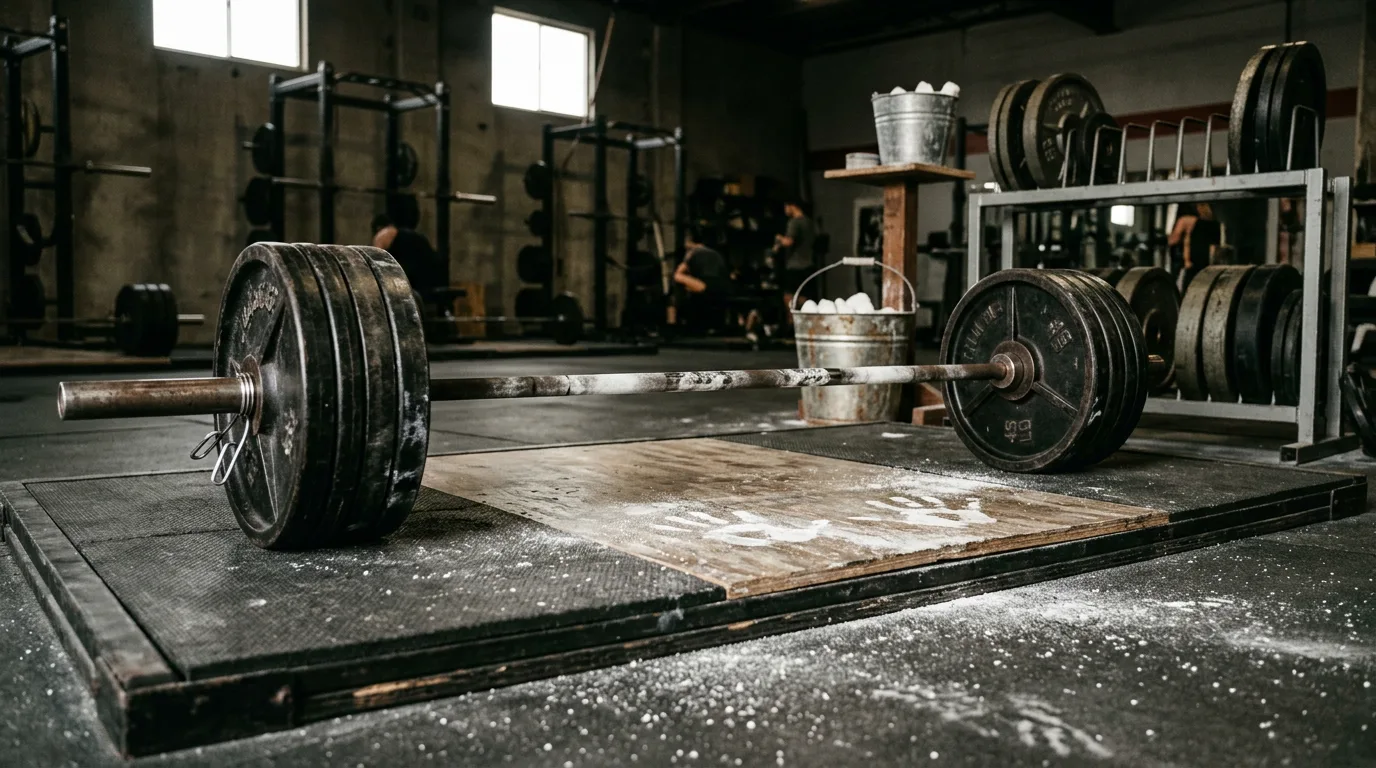
Why Deadlifts Demand Better Chalk
Every other barbell lift has a structural advantage for grip. The squat rests on your back. The bench press sits in your palms with gravity pressing the bar into your hands. The overhead press is vertical but light compared to your pull. The deadlift is the opposite — the full load hangs from your fingers, and gravity pulls the bar straight down and away from your grip.
This loading pattern means the bar sits primarily in your fingers, not your palm. The contact zone is the finger pads and the crease at the base of each finger, where the bar naturally settles during the pull. Any moisture in this narrow zone causes the bar to migrate toward your fingertips and eventually roll out. Powder chalk addresses this, but the loose particles can actually fill bar knurling (reducing the mechanical interlocking pattern) and degrade as sweat seeps underneath the surface layer during rest between sets.
Liquid chalk bonds differently. The alcohol carrier deposits the magnesium carbonate into the fine ridges and pores of your skin, creating a thin layer that becomes part of your skin surface rather than sitting on top of it. This bonded layer meshes with the bar knurling instead of filling it, and resists sweat penetration because the alcohol evaporation process locks the particles in place. The result is a grip that feels more secure than powder alone and lasts longer between applications.
Application by Grip Type
Double Overhand Grip
The weakest grip for heavy deadlifts but the best for building raw grip strength. Both palms face you, and the bar pulls hardest against your finger flexors. Chalk coverage needs to be thorough: all four finger pads, the first knuckle crease, and the thumb pad (where the thumb wraps over the fingers). The bar tends to roll toward the fingertips under heavy load — extra chalk on the proximal finger pad helps resist this roll.
Double overhand works for warm-up sets and moderate working sets. The point where you switch to mixed grip or hook grip depends on your grip strength — chalk extends that threshold by reducing the moisture variable, letting your muscles do more of the work.
Mixed Grip (Over-Under)
One hand pronated (overhand), one supinated (underhand). The opposing hand positions cancel out the bar's rotational tendency, allowing heavier loads than double overhand. The supinated hand is the vulnerable one — the palm faces up, which means sweat pools on the gripping surface rather than dripping off. Apply 50% more chalk to the supinated hand than the pronated hand.
The supinated hand also experiences a different loading pattern. The bar rests deeper in the palm and loads the mid-finger zone more than the fingertips. Cover the full finger and mid-palm area on the underhand side. On the overhand side, the standard fingertip-focused application works.
Hook Grip
Hook grip locks the bar by trapping the thumb between the bar and the index and middle fingers. It is the strongest grip variation for raw pulling (no straps) and the standard for Olympic weightlifting. The downside is the thumb compression — it hurts, and the grip demands on the thumb-finger contact zone are extreme.
Chalk every surface in the hook grip chain: thumb pad (where it contacts the bar), thumb nail side (where the fingers press), inside of the index finger (where it presses the thumb), and the inside of the middle finger. Any moisture in the thumb-finger interface causes the thumb to slip, which collapses the entire grip. Liquid chalk is particularly effective here because the bonded layer resists the sweat that accumulates in the tight space between thumb and fingers.
Some hook grip users apply chalk, then wrap their thumbs with athletic tape for additional friction. The chalk-and-tape combination reduces both moisture and the pain of thumb compression. If you tape, apply chalk first (to your skin), then tape, then apply a light chalk coat to the outside of the tape.
Conventional vs Sumo: How Stance Changes Chalk Strategy
The grip demands of conventional and sumo deadlifts are mechanically identical — the bar sits in the same hand position regardless of stance width. But the body position around the grip differs, and that affects how sweat reaches your hands.
In a conventional stance, your arms hang straight down outside your knees. Sweat from your forearms and wrists can drip down onto your palms, but the drip path is mostly behind your hands. In a sumo stance, your arms hang between your knees, and your forearms are in closer proximity to your inner thighs — a warmer zone that generates more sweat. The sweat path runs forward along your forearms directly onto your palms and fingers.
For sumo pullers, extend your chalk application up to your wrists and the lower forearms. This creates a dry barrier that catches forearm sweat before it reaches your palms. A small additional amount on the inner forearm (the side facing your thighs) prevents the drip path that deposits moisture right where you grip the bar. Conventional pullers can skip the forearm application in most cases.
Session Structure: When to Apply and Reapply
Heavy Singles and Doubles
Sets: 3-6 working sets at 85-100% of max
Rest: 3-5 minutes between sets
Strategy: Apply before your first working set. The long rest periods keep the chalk intact — you are not sweating continuously like during a hypertrophy session. One application typically covers 4-5 heavy singles. Reapply before your heaviest attempt if you feel any moisture on your fingertips.
Volume Pulls (5x5, 3x8)
Sets: 3-5 working sets at 65-80% of max
Rest: 2-3 minutes between sets
Strategy: Apply before the first set. Higher rep counts generate more palm sweat per set, and the shorter rest periods do not allow full recovery. Expect to reapply once mid-session — typically before the 3rd or 4th set when the cumulative sweat starts to overpower the chalk layer.
Deficit and Rack Pulls
Deficit: Longer range of motion means longer time under tension — chalk has more time to degrade during each rep. Apply slightly heavier for deficit work.
Rack pulls: Supramaximal loads (above your full-range max) put extreme demand on grip. For rack pulls above 100% of your deadlift max, use the liquid chalk base plus powder chalk top-coat approach for maximum friction.
Touch-and-Go Reps
Reps: 8-20 per set without releasing the bar
Strategy: Each rep without a reset puts additional wear on your chalk layer. Apply heavier than normal before a touch-and-go set. Focus coverage on the fingertips — the bar migrates toward the ends of your fingers with each rep, and the fingertips need the most friction to prevent the bar from completing that migration and rolling out.
Top Picks for Heavy Pulling
Deadlift chalk needs to bond hard, resist sweat under load, and last through the rest periods between heavy sets. These five formulas earned their spots in the deadlift rotation.
1. Spider Chalk White Widow — Best for Max Attempts
White Widow's nano-resin formula provides up to 60 minutes of continuous grip. For a deadlift session of 5-8 heavy singles with 3-5 minute rest periods, that means zero reapplication. The extra-thick paste takes 25-30 seconds to dry — plan accordingly — but once bonded, it does not move. USAW and USAPL sanctioned. At premium for 8 oz with 400+ applications per bottle, the per-pull cost approaches zero.
Read our full Spider Chalk White Widow review | Check Price on Amazon
2. SPORTMEDIQ Pro Grade — Best for Training Volume
The 250ml pump bottle handles 4-6 deadlift sessions per week without running out. The rosin-enhanced formula creates a tackier grip that resists the bar's rotational roll in the fingers — the exact failure mode on heavy pulls. Over 3765 reviews at 4.7 stars. At premium for 250ml, the cost per session is negligible.
Read our full SPORTMEDIQ review | Check Price on Amazon
3. Liquid Grip — Best for Sweaty Hands
The water-based formula with USP-grade rosin is built for high-moisture situations. If your hands drip before you even touch the bar, this is the formula that handles the volume. The rosin creates a secondary tacky layer when the magnesium carbonate starts to wear, extending grip time past the 30-minute mark. At premium for 8 oz with 641 reviews at 4.7 stars.
Read our full Liquid Grip review | Check Price on Amazon
4. IRON AMERICAN Combo Kit — Best Home Gym + Meet Setup
The 8.3 oz bottle lives next to your deadlift platform at home. The 1.7 oz travel bottle clips to your belt for competition. The lifetime warranty adds confidence. At top-tier for both bottles, it is cheaper than buying separate products for training and meets. Grip quality is solid for all grip types, though heavy sweaters may prefer a rosin-enhanced alternative.
Read our full IRON AMERICAN review | Check Price on Amazon
5. EVMT Brands — Best Budget Entry Point
At affordably priced for 50ml, this is the lowest-commitment way to see if liquid chalk improves your deadlift. The "Weightlifting" variant works well on knurled bars. Over 3121 reviews at 4.6 stars prove it handles the basics. Grip duration of 25-35 minutes covers a typical heavy pulling session. Graduate to a large-bottle option once you are committed.
Read our full EVMT Brands review | Check Price on Amazon
The Hybrid Approach: Liquid Base + Powder Top Coat
For maximum grip on a true max-effort pull, the liquid-plus-powder combination outperforms either format alone. The technique is straightforward: apply liquid chalk, wait for full drying, then dip your hands in loose chalk immediately before gripping the bar.
The liquid layer bonds to your skin and creates a moisture barrier. The loose chalk sits on top and provides immediate dry friction against the knurling. The combination addresses both halves of the grip equation — the moisture problem (liquid) and the surface friction problem (powder). This is the standard protocol at national-level powerlifting meets, where lifters apply their own liquid chalk and then use the communal chalk bowl for the top coat before each attempt.
The downside is the mess. Loose chalk on top of liquid chalk still creates dust, still coats the bar, and still falls on the floor. For training in a commercial gym, stick to liquid only. Save the hybrid approach for competition or home gym sessions where mess is not a concern.
Deadlift Chalk Questions
Does liquid chalk work for hook grip deadlifts?
Should I chalk my fingers or my entire palm for deadlifts?
Does bar knurling type change which liquid chalk works best?
Can I use liquid chalk with lifting straps for deadlifts?
How much does liquid chalk actually add to a deadlift?
Is liquid chalk better than chalk blocks for heavy deadlifts?
Pull With Confidence
You did not build your deadlift to have it stolen by sweaty palms. The strength is there — you just need the friction to express it. Liquid chalk removes the moisture variable, lets you pull with full force, and keeps your hands on the bar where they belong. Pick the formula that matches your grip style and training volume, and never miss a pull to grip failure again.
Check Price on Amazon