Liquid Chalk for Bouldering: Flash Attempts and Clean Walls
Bouldering strips climbing to its purest form — just you, the problem, and the friction between your skin and the holds. Every attempt starts from the ground, the problems are short enough that one chalk application covers the full send, and the difference between sticking a crux hold and greasing off it often comes down to how dry your fingertips are in that instant. Liquid chalk bonds a moisture-resistant layer to your skin that outlasts loose powder, keeps gym holds cleaner, and eliminates the chalk cloud that hangs in busy bouldering gyms. This guide covers gym sessions, outdoor projects, competition strategy, and the specific formulas that boulderers trust.
Why Boulderers Are Moving to Liquid Chalk
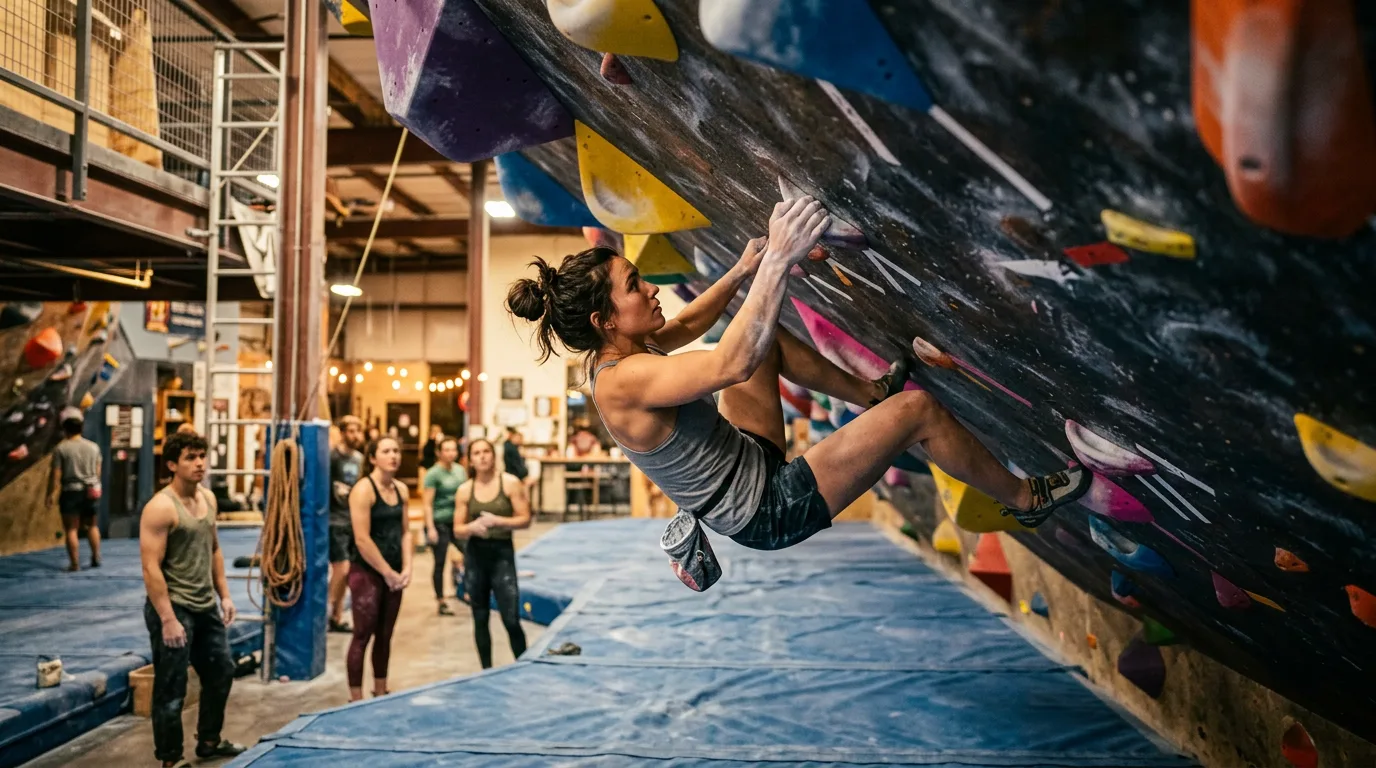
Walk into any busy bouldering gym on a Saturday and the air quality tells the story. Chalk dust hangs in suspension, coating holds, mats, and lungs. Fifty climbers dipping into chalk bags and clapping their hands creates a visible haze that irritates airways and settles on the textured surfaces of holds — ironically reducing the very friction that chalk is supposed to enhance.
Liquid chalk eliminates the airborne problem entirely. The alcohol carrier evaporates on your skin, leaving the magnesium carbonate bonded to your fingerprints without any loose particles entering the air. Zero dust. Zero hold contamination from airborne fallout. Zero white handprints on your black climbing pants.
For boulderers specifically, the short duration of problems makes liquid chalk particularly effective. A typical V4 boulder takes 15-45 seconds to complete. A single liquid chalk application, properly dried, provides 25-60 minutes of grip depending on the formula. That means one application covers your entire warm-up, your project attempts, and your cooldown problems with margin to spare. Powder chalk users typically rechalk between every attempt on a hard problem. Liquid chalk users can send three or four burns before the grip noticeably degrades.
The performance advantage is measurable on specific hold types. Slopers, volumes, and pinches — holds where friction between skin and surface determines success — benefit the most from the bonded layer that liquid chalk creates. On jugs and deep pockets, the advantage is smaller because geometry does more of the gripping work. If your project has even one sloper crux, liquid chalk can be the difference between a send and a session of near-misses.
How to Apply for Maximum Bouldering Performance
Bouldering demands maximum skin friction from the first hold. Unlike sport climbing where you can ease into a route, many boulder problems start with a hard move right off the ground. Your chalk application needs to be dialed before you pull on.
Squeeze a pea-sized amount onto your fingertips — not your palm. Boulderers grip primarily with their finger pads and the first knuckle crease. Spread the chalk across all four finger pads and the thumb pad, working it into the skin with circular motions. Then distribute the remaining residue across your palms for support grip on slopers and mantles. Wait the full drying time (10-25 seconds depending on formula) before touching the first hold.
The common mistake is applying to the palm center first and neglecting the fingertips. On a crimp-heavy problem, your palm is barely in play. On a sloper-heavy problem, your whole hand surface matters. Adjust your focus based on the hold types you see on the problem.
Projecting: How Chalk Strategy Changes at Your Limit
Working a project means back-to-back attempts on the same problem, often for an entire session. Your chalk strategy shifts from "apply once and climb" to "manage grip across 10-20 attempts on the same holds." The demands are different, and your approach should reflect that.
On your first attempt of the session, apply a full coat of liquid chalk. For the next 3-4 attempts, the bonded layer from that initial application is usually sufficient — just rub your hands on your pants between burns to remove loose debris and redistribute the remaining chalk. By attempt 5-6, your fingertips may start to feel slick, especially at the crux holds where you are gripping hardest. This is the time for a light reapplication — not a full coat, but a small amount focused on the specific fingers that are doing the most work on the crux.
The temptation is to rechalk between every single attempt. Resist it. Stacking fresh liquid chalk over a partially worn layer creates uneven coverage. The areas where the original layer is still intact get a double dose (too thick, flakes under pressure), while the worn areas get a single fresh layer (correct thickness). The result is inconsistent grip across your hand. If you must reapply, rub your palms briskly on your pants first to even out the surface, then apply a light, targeted amount.
Hold brushing is the other half of the projecting equation. Chalk builds up on holds over repeated attempts — from your hands and from every other climber who has tried the problem. A boar-hair brush removes the old, compacted chalk and exposes the textured hold surface underneath. Brush the crux holds before each attempt, chalk your hands fresh, and send.
Indoor vs Outdoor Bouldering Chalk Needs
Indoor and outdoor bouldering present different surfaces, conditions, and ethics. The same bottle of chalk serves both, but how you use it should change.
Indoor bouldering gyms maintain controlled environments — consistent temperature, humidity, and hold material. The polyurethane holds are textured but uniform. Liquid chalk excels here because the controlled conditions mean you can predict exactly how long your application will last. Apply once, climb for 30-40 minutes, reapply if needed. The bonded layer leaves minimal residue on holds, keeping them grippy for the next climber. This is why gym owners increasingly prefer liquid chalk over loose powder.
Outdoor bouldering introduces variables that indoor climbing eliminates. Rock type, air temperature, humidity, wind, and sun exposure all affect chalk performance. Sandstone absorbs chalk differently than granite. A 30°C day in Fontainebleau demands more frequent application than a 10°C day in Rocklands. Wind can cool your hands (reducing sweat) but also dry your skin too aggressively. For outdoor sessions, bring both liquid chalk and a chalk bag — use the liquid as a base and supplement as conditions demand.
The environmental angle matters outdoors. Chalk marks on rock faces are a contentious topic in many climbing communities. Liquid chalk's lower transfer rate means less visible chalk on holds and less impact on the rock surface. But "less" is not "none" — you will still leave marks, especially on dark rock. Brush holds after your session, remove tick marks, and follow the leave-no-trace principles of your local climbing community.
Best Liquid Chalk for Boulderers
Bouldering prioritizes fast dry time (you want to start climbing immediately after chalking), moderate tackiness (too sticky hinders dynamic moves and deadpoints), and minimal hold contamination. These five formulas match those priorities.
1. Spider Chalk Black Widow — Best for Projecting Sessions
The Grip-Lock Technology in Black Widow delivers 40-55 minutes of continuous grip — enough for an entire projecting session of 10-15 attempts without a full reapplication. The 4 oz compact bottle fits in a chalk bucket or clips to a chalk bag strap. Made in the USA with skin-friendly ingredients that will not destroy your fingertip skin during a 3-hour session.
At mid-range for 4 oz, this is priced for committed boulderers. With 588 reviews at 4.5 stars, the formula has been validated by climbers who push their skin to the limit. The nano-resin bond stays effective even as your hands warm up and start sweating during sustained attempts.
Read our full Spider Chalk Black Widow review | Check Price on Amazon
2. PowerGrip 50ml — Best for Extended Grip on Slopers
PowerGrip's honey and rosin blend creates a secondary tacky layer that activates when the primary chalk layer starts to wear. For boulderers working sloper-heavy problems, that secondary grip can mean the difference between sticking the crux and greasing off. The 50ml travel size tucks into a chalk bucket, and the honey component gives a smoother feel than pure rosin products.
At budget-friendly for 50ml, the per-application cost is competitive. With 444 reviews at 4.6 stars (shared across both sizes of the PowerGrip line), the formula has broad validation. Grip duration of 35-50 minutes outlasts most competitors in this size class.
Read our full PowerGrip 50ml review | Check Price on Amazon
3. EVMT Brands Rock Climbing Variant — Best Everyday Gym Chalk
The EVMT "Rock Climbing" formula dries in 10-15 seconds — the fastest in our catalog — which matters when you are rotating between problems every 2-3 minutes. At affordably priced for 50ml, it is the most accessible entry point for boulderers trying liquid chalk for the first time.
Over 3121 reviews at 4.6 stars, with a large portion of that community being indoor climbers. Grip duration of 25-35 minutes covers a standard gym session. The formula is not the grippiest available, but the fast dry time and low cost make it the default daily driver for casual boulderers.
Read our full EVMT Brands review | Check Price on Amazon
4. Chalkless CLEAR — Best for No-Chalk Gyms
For bouldering gyms that ban all chalk — even liquid — Chalkless CLEAR's invisible silica silylate formula provides grip with zero residue. Your hands feel dry and grippy without any white marks on holds, hands, or walls. At top-tier for 8g, the cost is steep, but it solves an otherwise unsolvable problem.
Over 826 reviews at 4.5 stars. The grip feel is different from traditional chalk — a dry friction rather than the powdery coating you may be used to. Give it 2-3 sessions to adjust to the new sensation before judging the effectiveness.
Read our full Chalkless CLEAR review | Check Price on Amazon
5. WARM BODY COLD MIND — Best for Outdoor Bouldering
The pure magnesium carbonate formula with zero additives leaves the least residue on rock of any liquid chalk we tested. For outdoor boulderers who care about minimizing chalk marks on natural stone, this is the environmentally conscious choice. The twin 50ml pack means one bottle in the crash pad pocket and one in the car as a backup.
At mid-range for two bottles, the cost is fair. Over 1071 reviews at 4.6 stars from a mixed community of lifters and climbers. The quick 10-15 second dry time works well in outdoor conditions where wind can actually speed up evaporation.
Read our full WARM BODY COLD MIND review | Check Price on Amazon
Competition Bouldering Chalk Protocol
Competition bouldering at the IFSC and USA Climbing level follows a specific format: isolation zone, then 4-5 minutes per boulder with rest between. Your chalk strategy should match the competition rhythm rather than your normal training routine.
In the isolation zone, apply a full coat of liquid chalk 5-10 minutes before your group is called to the wall. This gives the chalk time to fully bond and the alcohol to completely evaporate. A fresh application right before climbing can leave a faint alcohol residue that slightly reduces grip for the first 30 seconds.
Between boulders, wipe your hands on your pants to remove debris and redistributing remaining chalk. If the venue provides a chalk station, a quick dip in loose chalk on top of your liquid base gives maximum grip for the next problem. If no chalk station is available, a small squeeze of liquid chalk focused on your fingertips refreshes the coverage for each new boulder.
The mental aspect matters as much as the physical. Chalking up between boulders is a ritual that resets your focus. Use the 20-30 seconds of application and drying as a mental transition — visualize the next problem's sequence, calm your breathing, and step to the wall with your hands dry and your mind clear.
Questions Boulderers Ask About Chalk
How often should I reapply liquid chalk during a bouldering session?
Does liquid chalk reduce friction on plastic bouldering holds?
Is liquid chalk allowed at IFSC and USA Climbing bouldering competitions?
Can I mix liquid chalk brands to get a better formula?
Why do my hands feel worse after using liquid chalk all session?
What is the best way to warm up with liquid chalk for bouldering?
Stick the Send
Your project is waiting. The beta is dialed, the conditions are right, and the only variable left is whether your skin holds the crux. Liquid chalk takes moisture out of the equation and lets your training speak through your fingertips. Pick the formula that matches your climbing style and go send.
Check Price on AmazonGet Our Top 3 Picks
Get our top 3 picks for your budget — one email, then only updates.
Only when something changes. Unsubscribe anytime.