Liquid Chalk for Bench Press: The Back Tack Advantage
Most lifters think about bench press chalk in terms of hand grip — palms on the knurling, fingers locked around the bar. But the bench press has a grip problem that no other barbell lift shares: your back slides on the bench pad. A sweaty upper back on vinyl loses the tight arch, the retracted scapulae, and the drive position that competitive bench pressers spend years perfecting. Liquid chalk applied to both hands and upper back transforms bench press stability. This guide covers the back tack technique, hand grip optimization for different bench variations, when chalk matters more than other accessories, and the formulas that handle both contact surfaces.
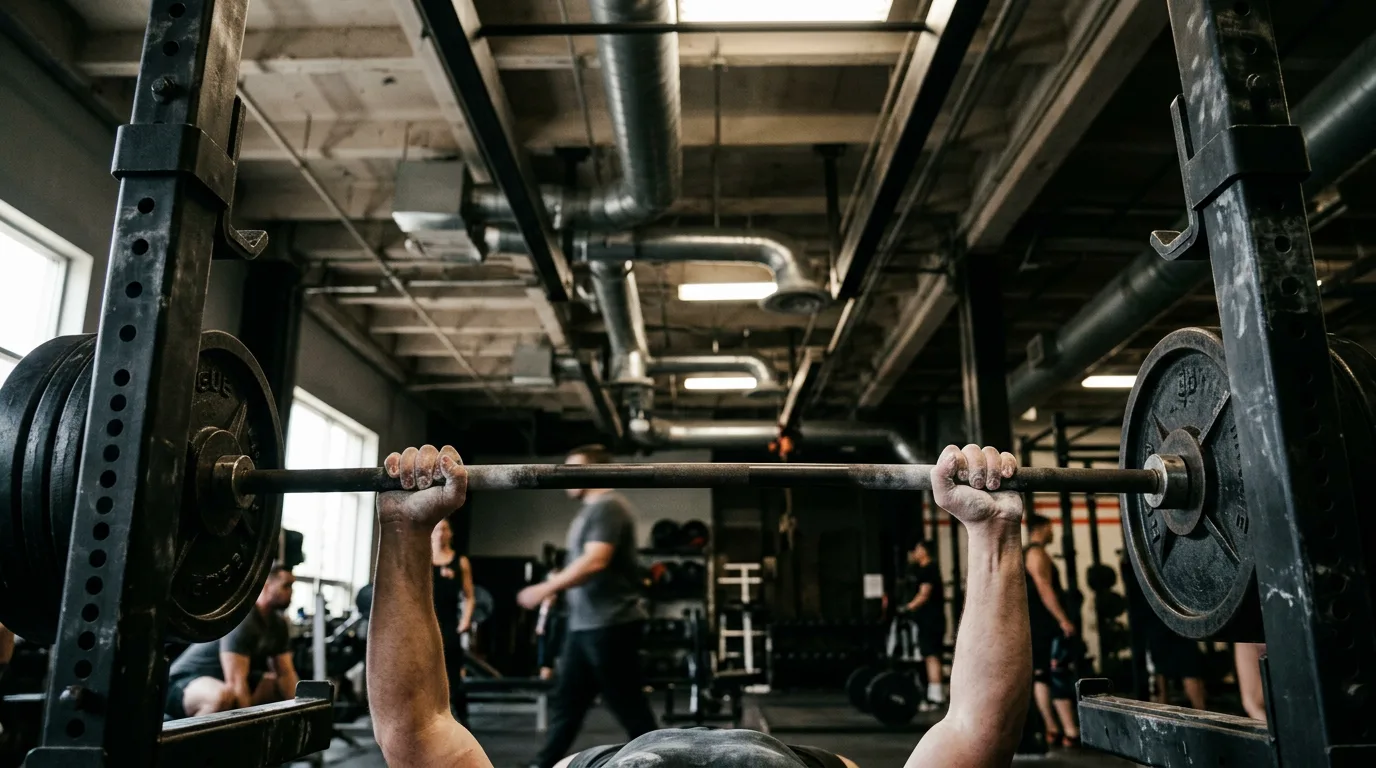
Back Tack: The Overlooked Bench Press Advantage
Watch any competitive bench presser set up and you will see them chalk their upper back before lying on the bench. This is not superstition. The physics are straightforward: when you press a heavy barbell, the bar moves in a slight arc from chest to lockout. Your shoulder blades should remain retracted and depressed throughout the lift — pinched together and pulled down into the bench pad. If your back slides on the pad, your shoulders protract, your arch flattens, and the force transfer from chest to bar degrades.
Sweat makes this worse with every set. The first rep of your first working set might feel solid. By the third set, your back is wet, the bench pad is wet, and you are fighting to maintain position between reps. Each micro-slide costs pounds off your press because you are pressing from a compromised position. Over a full bench session with 5-8 working sets, the cumulative effect of progressive back slide is measurable — lifters report 5-15 pound strength differences between chalked and unchalked sessions at heavy loads.
Liquid chalk works for back tack because it bonds to both skin and fabric. If you bench in a t-shirt, apply chalk to the shirt's upper back — the magnesium carbonate grips the cotton or polyester fibers and creates friction against the vinyl pad. If you bench shirtless or in a tank top with exposed upper back, apply directly to the skin across both scapulae. Either way, the bonded chalk layer creates a non-slip surface that maintains your arch through the entire session.
Hand Grip: Where Knurling Meets Chalk
While back tack is the bigger performance factor, hand grip still matters — especially on heavy singles and max-effort work where the bar tends to drift forward in sweaty palms. The bench press uses a specific grip pattern: the bar sits in the heel of the palm, fingers wrap around from below, and the wrist stays stacked over the forearm. Any rotation of the bar in your hand shifts the load path and increases injury risk to the wrists and shoulders.
Liquid chalk applied to palms and fingers locks this grip position. The magnesium carbonate fills the micro-gaps between your skin and the bar's knurling pattern, increasing the friction coefficient. On a standard Olympic barbell, the center knurling (if present) contacts your back, and the outer knurling sections contact your palms. Competition power bars have aggressive knurling specifically designed for chalk use — the diamond pattern grabs chalked skin harder than smooth skin.
For the standard medium-grip bench (hands at roughly 1.5x shoulder width), chalk coverage needs to extend from fingertips across the full palm to the heel. Many lifters miss the heel of the palm — this is where the bar seats, and it is the point most likely to generate sweat under pressure. A thorough application that covers the entire palm surface produces a more secure bar seat than just chalking the fingers.
Bench Press Variations and Grip Demands
Competition Bench Press
Maximum arch, maximum back tack, competition pause on chest. Chalk both hands and full upper back. The pause on chest allows any back slide to manifest — your position must be locked before the press command. Competition bench benefits most from back chalk because the forced pause eliminates momentum that might compensate for sliding in touch-and-go reps.
Close-Grip Bench
Hands inside shoulder width, emphasizing triceps. Narrower grip means less bar surface contacting each palm, making friction per square centimeter more important. Chalk the full palm with extra attention to the heel where the bar seats. Back tack is equally important — the narrower hand position creates a longer moment arm from shoulder to hand, amplifying any back slide into greater shoulder instability.
Wide-Grip Bench
Hands at or near the 81cm ring marks. Wide grip increases chest recruitment but puts the wrists at a greater shear angle. Chalk helps maintain the bar seat in the heel of the palm — without it, the bar can roll forward toward the fingers under heavy load, hyperextending the wrists. Back tack remains critical since wide grip creates a shorter range of motion that reduces the tolerance for positional errors.
Floor Press
Back lies flat on the floor or mat — no bench pad. Back tack is irrelevant since the floor provides friction naturally. Hand chalk matters more here because the floor press has no leg drive and no arch to assist, making the upper body grip the sole stability factor. A chalked grip keeps the bar path consistent through the shortened range of motion.
Session Strategy: When to Apply and Reapply
A typical bench press session involves warm-up sets, working sets, and possibly accessory press work. The chalk strategy should match the intensity curve — not a single application at the start that fades by your heaviest sets.
During warm-ups (bar, 135, 185, etc.), skip the chalk. Warm-up weights do not challenge grip or back position. Save the chalk for when the weight gets heavy enough to press your body into the bench pad with force. For most intermediate lifters, that threshold is around 70% of their one-rep max.
Apply liquid chalk to hands and back before your first working set. This single application typically lasts 3-4 sets — roughly 15-20 minutes of lifting with rest periods. If you are running a high-volume program with 6-8 working sets, reapply at the midpoint. The indicator is feel: when you sit on the bench and set up, do your shoulder blades grab the pad or slide? If they slide, reapply.
For max-effort singles or competition-style attempts, apply a fresh coat before each attempt. The stakes are highest, the weight is heaviest, and any position loss costs the lift. Fresh chalk for fresh attempts is cheap insurance.
Chalk vs Other Bench Press Accessories
Bench press has an accessory ecosystem — wrist wraps, bench shirts, SBD-style knee sleeves worn on elbows, grip tape, and chalk. Understanding where chalk fits relative to these tools prevents redundancy and ensures you use the right tool for the right problem.
Wrist wraps stabilize the wrist joint. Chalk stabilizes the bar-to-hand interface. These address different failure points and stack well together. A lifter with sweaty hands and weak wrists benefits from both. A lifter with dry hands and strong wrists might skip chalk for hand grip but still benefit from back tack. The tools are complementary, not redundant.
Bench shirts and boards restrict range of motion. Chalk does not affect ROM at all. Elbow sleeves provide joint warmth and mild compression. Chalk addresses grip friction. There is no overlap between chalk and these accessories. The only scenario where chalk might not be needed is when using a bench with a rubberized or textured pad surface that provides built-in tack — some high-end gym equipment manufacturers now offer this, though most commercial and home gym benches still use smooth vinyl.
Best Liquid Chalk for Bench Press
Bench press needs a formula that works on two different surfaces — skin-to-bar (hands) and skin-to-vinyl (back). Some formulas excel at one but not the other. These picks handle both contact situations and come in volumes that match the double-application demands of bench sessions.
SPORTMEDIQ Pro Grade Liquid Chalk — Best Overall for Bench
Thick formula that covers large back areas efficiently in a single application. High MgCO3 concentration bonds to both skin and fabric for reliable back tack. The large bottle at premium handles the double application demands — hands and back — without running out mid-training cycle. The consistency is ideal for spreading across the scapular region.
Check Price on AmazonIRON AMERICAN Liquid Chalk Combo Kit — Best for Heavy Singles
Maximum-grip formula designed for powerlifting applications where every pound counts. The aggressive MgCO3 concentration creates the driest possible surface on palms and back. At top-tier, it suits lifters training in the 85-100% one-rep max range where grip security is a safety concern, not just a performance factor.
Check Price on AmazonLiquid Grip 8oz Bottle — Best for Volume Training
Balanced formula that holds through extended sessions without excessive buildup. At premium for the bottle size, the per-application cost stays manageable even when chalking hands and back across 6-8 working sets. Good for programs like 5/3/1 or Sheiko where bench volume is high and sessions run 60-90 minutes.
Check Price on AmazonSpider Chalk White Widow 8oz — Best for Warm Gyms
For lifters training in hot, poorly ventilated gyms or summer garage setups, sweat production is the primary challenge. This formula handles high moisture output with a drying agent blend that absorbs beyond the initial application layer. At premium, it is purpose-built for the conditions where back slide is worst — when you are already sweating before the first warm-up set.
Check Price on AmazonWARM BODY COLD MIND Liquid Chalk — Best for Skin Comfort
Conditioning additives protect hand and back skin through frequent chalk use. If you bench three times per week and chalk both hands and back each session, the cumulative alcohol exposure adds up. This formula at mid-range mitigates the drying effect while maintaining grip performance. The skin stays healthy rather than cracked and raw through a full training block.
Check Price on AmazonBench Press Chalk Errors That Limit Your Press
These mistakes reduce the effectiveness of chalk on bench press. Most are easily corrected once identified.
Chalking hands but not back. Hand grip failure is rare on bench press — the bar sits in a cradle formed by your palms. Back slide is the real performance leak. If you only chalk one surface, make it your back. Both is best, but back matters more than hands for most bench pressers.
Applying right before lying down. The back application needs 30-60 seconds to dry fully. If you apply and immediately lie on the bench, the wet alcohol layer acts as a lubricant against the vinyl. Wait for complete drying — dry to the touch, white and powdery — before setting up.
Skipping chalk on warm-up sets then wondering why working sets feel off. Apply chalk before your first working set, not your first warm-up. But do set up on the bench during warm-ups the same way you will during working sets — this lets you confirm your positioning before the weight gets heavy.
Using chalk as a substitute for proper setup. Chalk enhances a good setup — it does not fix a bad one. If your scapulae are not retracted and depressed, if your arch is flat, if your foot position is wrong, chalk will not save the lift. Fix your setup mechanics first, then add chalk to preserve that position under load.
Bench Press Chalk Questions Answered
Why do bench pressers chalk their backs?
The biggest performance leak on bench press is not hand slip — it is back slide. When your upper back slides on the vinyl bench pad during heavy reps, you lose the tight arch and shoulder retraction that transfers force from your chest to the bar. A chalked back sticks to the bench surface, maintaining your set position through every rep. Competitive bench pressers consider back chalk more important than hand chalk because position stability drives more weight than grip alone.
Does liquid chalk leave stains on gym bench pads?
Liquid chalk deposits a thin magnesium carbonate film that wipes off vinyl and leather bench pads with a damp cloth or spray cleaner. It does not stain the material the way chalk paste or colored chalk products might. In commercial gyms, wipe the bench pad after your sets — this takes 10 seconds and is standard gym courtesy. The residue is far less than what block chalk leaves on the same surface.
Should I chalk my hands or use wrist wraps for bench press?
These solve different problems. Chalk improves the friction between your palm and the bar knurling — you grip the bar more securely. Wrist wraps stabilize the wrist joint to prevent hyperextension under heavy loads. Many serious bench pressers use both: chalk for grip, wraps for wrist support. If you must choose one, chalk addresses the more immediate safety concern — a bar slipping out of sweaty hands is more dangerous than a slightly flexed wrist.
How do I apply liquid chalk for bench press back tack?
Apply to the upper back, across the scapulae and rear deltoids — the areas that contact the bench pad. Squeeze a quarter-sized amount, spread it across both shoulder blades using the opposite hand (reach across), then spread any remainder across the trapezius area. Let it dry 30 seconds. You can also apply to the back of your shirt if your gym does not allow skin-to-bench chalk contact. The chalk bonds to cotton and polyester fabric and provides nearly the same tack.
Is chalking necessary for bench press under 225 pounds?
Grip failure on bench press is rare at lighter weights for most lifters. The real benefit of chalk at any weight is back tack — preventing your shoulders from sliding on the bench pad during the eccentric phase. If you bench with a tight arch and retracted scapulae, back tack matters starting around the point where the weight is heavy enough to press you into the bench pad and cause shifting. For many lifters that happens around 60-70% of their one-rep max, regardless of the absolute weight.
Can liquid chalk help with close-grip bench press?
Close-grip bench places hands inside shoulder width, which reduces your grip contact with the bar knurling. The narrower grip means less bar surface contacts your palm, making each friction point more important. Liquid chalk matters more on close-grip than on standard grip for this reason. The reduced contact area also means your wrists bear more shear force — combine chalk for grip with wrist wraps for support on heavy close-grip work.
Lock In Your Bench Setup
Back tack and hand grip together give you the positional stability that turns good bench technique into personal records. Grab our top bench press chalk pick and feel the difference on your next heavy session.
Check Price on AmazonGet Our Top 3 Picks
Get our top 3 picks for your budget — one email, then only updates.
Only when something changes. Unsubscribe anytime.