Benefits of Liquid Chalk: Why Athletes Make the Switch
Liquid chalk solves a problem that powder chalk only partially addresses: how to keep a dry, high-friction grip without creating a mess that gets you banned from your gym. But cleanliness is just the starting point. The measurable advantages span grip consistency, duration, portability, skin health, and training safety.
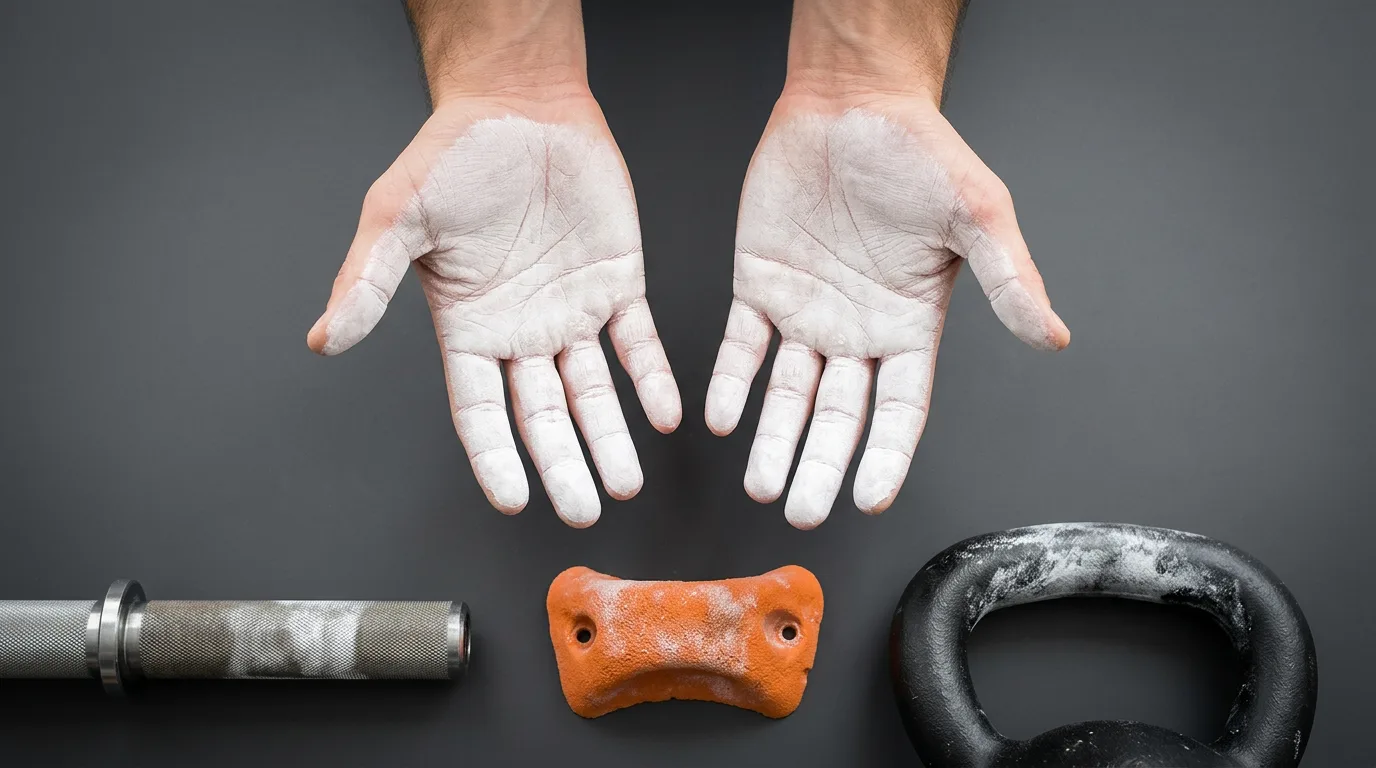
We're not going to pretend liquid chalk is magic. It's a grip tool with specific, provable benefits — and a few trade-offs worth knowing about. Here's what the switch from powder to liquid actually changes in your training.
No Airborne Dust
The number-one reason gyms allow liquid chalk and ban powder: zero dust clouds. Powder chalk creates visible airborne particles every time an athlete claps their hands, re-dips in a chalk bucket, or performs a dynamic movement. Those particles settle on equipment, mirrors, floors, and HVAC filters — costing the facility money in cleaning and maintenance.
Liquid chalk eliminates this entirely. The alcohol carrier bonds the magnesium carbonate to your skin during the drying phase. Nothing becomes airborne. Nothing settles on the lat pulldown machine across the gym. The only evidence of liquid chalk use is a faint white residue on the bar you just gripped — and that wipes off with a quick towel swipe.
For athletes, this means you can chalk up in front of the strictest gym manager and get a nod instead of a warning. For gym owners, it means they can offer chalk-friendly training without the cleanup overhead. Both sides win.
Even, Consistent Coverage
Powder chalk application is inherently variable. The amount you pick up from the bag differs each time. Some spots on your palm get over-chalked while others stay bare. Clapping off the excess removes the inconsistency somewhat, but the coverage is never uniform.
Liquid chalk, by contrast, spreads across your palms as a thin, even film — the same way lotion covers skin. Every square centimeter of your gripping surface gets the same chalk density. There are no bare spots, no thick clumps, and no excess to clap off.
This consistency has a measurable effect on grip. A uniform chalk layer creates maximum friction across the entire contact area. Uneven powder coverage means some parts of your hand grip well while others don't — and grip strength is limited by the weakest point of contact.
Longer Grip Duration
Powder chalk sits on top of your skin. The first time you grip a barbell, much of the powder transfers to the bar. By the second set, coverage is already degrading. By the third set, most lifters need to re-chalk.
Liquid chalk bonds to skin during the alcohol evaporation phase. This bonded layer resists transfer to equipment much more effectively than loose powder. A single application of standard liquid chalk typically lasts 2–6 sets before needing refreshing. Premium formulas with rosin or nano-resin additives can hold through an entire 45–60 minute session.
The practical impact: fewer interruptions to your workout. Instead of visiting the chalk bucket between every heavy set, you chalk up once at the start and maybe once more halfway through. For timed activities like CrossFit WODs or climbing competitions where every second counts, the reduced reapplication frequency is a direct performance advantage.
Gym Compatibility
A 2023 survey of the 50 largest commercial gym chains in the US found that roughly 80% allow liquid chalk while only 30% allow powder chalk. The remaining 20% ban all chalk products. For the millions of athletes who train at commercial facilities, liquid chalk is often the only legal grip option.
This matters more than most people realize. Training without any chalk means accepting grip as a limiting factor — especially on pulling movements. Deadlifts, rows, pull-ups, and farmer's walks all become harder when your palms are sweaty. For lifters who've outgrown the "bare hands" phase, liquid chalk is the bridge between needing grip assistance and being allowed to use it.
Portability
A chalk bag is a dedicated piece of equipment. It takes up space in your gym bag, creates a mess when it spills (and it always spills eventually), and needs to be kept sealed to prevent the chalk from absorbing ambient moisture and clumping.
A 50ml liquid chalk bottle is the size of a travel hand sanitizer. It clips to a gym bag strap with a carabiner, fits in a pocket, and can't create a chalk explosion when your bag tips over. For athletes who train at different locations — a home gym, a commercial gym, an outdoor climbing crag — the portability advantage is obvious.
Travel compounds this advantage further. TSA allows liquid chalk in carry-on bags (under the 3.4 oz / 100ml liquid rule), making it travel-friendly for athletes who compete or train while traveling. A chalk bag on an airplane creates questions at security. A small liquid bottle doesn't.
Reduced Callus Tearing
Callus tears are a common training injury in any sport involving repetitive gripping. They happen when excess skin buildup on the palm catches on a bar or hold and rips under load. Powder chalk can actually worsen this by creating a gritty, high-friction surface that grabs calluses during bar movement.
Liquid chalk creates a smoother friction surface. The bonded layer reduces the grabbing action that tears calluses while still providing enough friction to prevent slipping. Many high-rep athletes — CrossFitters doing 50-rep pull-up sets, kettlebell sport athletes doing 10-minute snatch tests — report fewer hand tears after switching from powder to liquid chalk.
This doesn't mean liquid chalk prevents all tears. Callus management (filing, moisturizing) is still necessary. But the smoother friction profile of a liquid chalk layer is demonstrably less aggressive on skin than loose powder chalk, especially during dynamic movements where the bar or handle rotates in the hand.
Skin Hygiene
Shared chalk buckets in gyms are bacterial breeding grounds. Multiple athletes dipping sweaty hands into the same container creates ideal conditions for transmitting skin infections — ringworm, impetigo, staphylococcus, and other gym-acquired nasties.
Liquid chalk sidesteps this entirely. Each athlete uses their own bottle with their own dispensing mechanism. No shared contact surface. And the alcohol carrier provides a mild antiseptic effect during every application, killing surface bacteria on the hands before training begins.
This isn't a trivial benefit. Skin infections from gym contact are common enough to have their own clinical literature. Using a personal liquid chalk bottle instead of a communal chalk bucket is one of the simplest hygiene improvements an athlete can make.
Training Safety
Grip failure under load is a safety issue, not just a performance issue. A barbell slipping out of your hands during a deadlift can cause back injuries from sudden unloading. A failed grip on a heavy overhead press puts you at risk of dropping weight on yourself. Even a pull-up bar slip from a height can cause wrist and shoulder injuries.
Liquid chalk reduces the probability of grip failure by maintaining consistent friction between your skin and the equipment. It doesn't make you invulnerable — no chalk can prevent failure under truly maximal loads where grip strength is exceeded — but it removes the variable of sweat-induced slip from the equation.
For athletes training alone in home gyms without spotters, this safety margin is especially valuable. Every failed rep due to grip slip is a potential injury scenario that could have been prevented with a 10-second chalk application.
Cost Efficiency
Liquid chalk is one of the cheapest training tools available on a per-use basis. A mid-range 50ml bottle provides 30–60 applications. A 250ml bottle provides 200–400+ applications. Even at the premium end of the market, the cost per workout session ranges from a few cents to about fifty cents — less than a single serving of protein powder.
Compared to other grip aids — straps, hooks, gloves — liquid chalk is also the least intrusive. It doesn't change your grip mechanics, doesn't add material between your skin and the bar, and doesn't require adjustment between exercises. You apply it and forget about it until the grip fades.
The Trade-Offs (Because Nothing Is Perfect)
Liquid chalk isn't without downsides, and acknowledging them makes the benefits more credible.
Skin drying: The alcohol carrier strips moisture from skin with repeated daily use. This is manageable with post-workout moisturizing, but it's real. Athletes who train twice daily will notice it more than occasional gym-goers.
Not as grippy at peak: For a single maximal rep, a fresh application of loose powder chalk provides marginally more surface friction than liquid chalk alone. This is why the layering technique (liquid base + powder top) exists. For 99% of training volume, liquid chalk alone is sufficient. For 1RM attempts and competition lifts, the combination is optimal.
Alcohol smell: The initial application smells like rubbing alcohol. It fades in 15–30 seconds, but the first few seconds can be intense in enclosed spaces. Scented products (like SURVIVOR's orange formula) address this, but most standard products have the characteristic IPA smell.
Requires dry time: Unlike powder chalk (instant application), liquid chalk needs 10–30 seconds to dry. For most training contexts, this is negligible. For rapid-transition workouts or competition scenarios with tight timing, it requires planning your application a beat earlier.
Liquid Chalk Benefits: Your Questions
Is liquid chalk better than powder chalk?
For cleanliness and consistency, yes. Liquid chalk creates less mess, applies more evenly, and bonds to skin longer. For absolute peak friction on a single heavy rep, some athletes prefer layering powder chalk over a liquid chalk base. The two formats complement each other rather than competing directly.
Does liquid chalk improve strength?
Not directly — it doesn't make your muscles stronger. But it removes grip as a limiting factor. If your deadlift fails because the bar slips out of your hands at 315 pounds, and chalk lets you hold it through lockout, the practical effect is a stronger pull. The strength was always there; the grip was the bottleneck.
How much does liquid chalk improve grip?
Chalk increases the friction coefficient between skin and steel by roughly 40–60% compared to bare sweaty hands. The exact improvement depends on the formula, your sweat rate, and the surface texture of the equipment. On knurled barbells, the improvement is substantial. On smooth chrome, it's even more pronounced.
Can liquid chalk help with sweaty hands?
Yes — that's its primary function. Magnesium carbonate absorbs moisture from your palms, eliminating the sweat film that causes slipping. Athletes with hyperhidrosis (excessive sweating) should look for thick-paste or rosin-enhanced formulas that absorb more moisture and last longer than basic formulas.
Is liquid chalk worth the cost?
For any athlete who trains with barbells, does pull-ups, or climbs regularly, liquid chalk pays for itself in reduced frustration and safer lifting. A mid-range bottle costs the equivalent of a few protein bars and lasts weeks. Compared to the cost of gym memberships, equipment, and supplements, chalk is one of the cheapest performance tools available.
Get Grip Tips Delivered
One email per week. Honest reviews, no spam.
Only when something changes. Unsubscribe anytime.