Is Liquid Chalk Vegan & Cruelty-Free? Ingredient Analysis
The majority of liquid chalk products are vegan and cruelty-free. The core ingredients — magnesium carbonate (a mineral) and isopropyl or ethanol alcohol (synthetic or plant-derived) — contain no animal products and require no animal testing. But a few formulas include honey, and ingredient transparency varies widely across brands. Here is the full analysis for athletes who care about what goes on their skin.
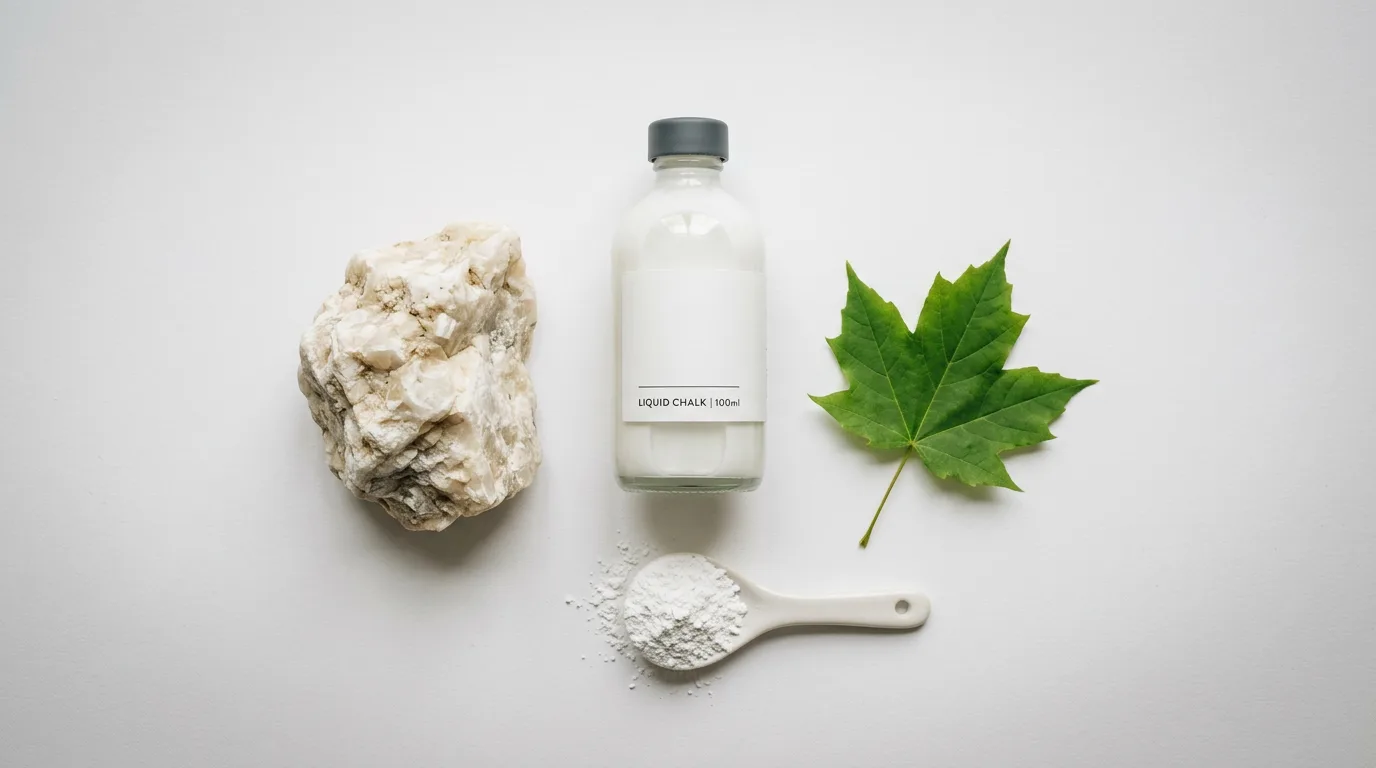
We examined the ingredient lists and manufacturer disclosures for all 19 products in our catalog. The findings are straightforward: most liquid chalk passes vegan scrutiny easily, one category of ingredients requires attention (honey-containing formulas), and animal testing is not a factor in this product category.
The Core Ingredients: All Vegan
Every liquid chalk formula starts with the same two base ingredients. Both are unambiguously vegan.
Magnesium Carbonate (MgCO3)
Magnesium carbonate is an inorganic mineral compound. It occurs naturally as the mineral magnesite, mined from geological deposits worldwide. Commercial magnesium carbonate can also be synthesized from seawater or brine by reacting magnesium salts with carbon dioxide — a purely chemical process.
No animal products, animal byproducts, or animal-derived materials are used in the production of magnesium carbonate at any stage. It is classified as vegan by every major certification body (The Vegan Society, Vegan Action, PETA). The same compound appears in food products (E504 additive, used as an anti-caking agent in table salt and powdered spices), antacid tablets, and cosmetics — all with vegan classification.
Alcohol Carriers (Isopropyl Alcohol and Ethanol)
Isopropyl alcohol (IPA): Manufactured from propylene, a byproduct of petroleum refining, through catalytic hydration. The entire production chain is mineral and chemical — no biological inputs at any stage. Unambiguously vegan.
Ethanol: Produced by fermentation of plant sugars (typically corn, sugarcane, or wheat) followed by distillation. Some ethanol production uses isinglass (fish bladder) or gelatin as a fining agent during purification — but this applies to beverage-grade alcohol production, not industrial ethanol. The ethanol used in liquid chalk is industrial grade and does not undergo fining processes that involve animal products. It is vegan.
The bottom line: the two ingredients that make up 95-99% of most liquid chalk formulas are both vegan, both cruelty-free, and both have extensive safety documentation that did not require animal testing.
Additives: Where Vegan Status Gets Complicated
The 1-5% of the formula that differentiates products from each other is where vegan athletes need to read labels carefully.
Rosin (Colophony) — Vegan
Rosin is a solid resin obtained from pine trees. The extraction process involves scoring the bark of living pine trees, collecting the sap (oleoresin) that flows out, and heating it to separate the volatile turpentine from the solid rosin. This is entirely plant-based — no animal involvement at any stage.
Rosin is used in liquid chalk to add tackiness beyond what magnesium carbonate provides alone. Products containing rosin (Liquid Grip, Spider Chalk White Widow, PowerGrip) pass vegan screening on the rosin ingredient specifically.
The allergenic concern with rosin is not related to animal products — it is related to plant allergies. People with sensitivities to pine, spruce, or tree saps may react to rosin. This is a dermatological concern, not a vegan one.
Honey — Not Vegan
Honey is the one ingredient in the liquid chalk category that fails strict vegan criteria. Produced by honeybees (Apis mellifera) from flower nectar, honey is classified as an animal product by The Vegan Society and virtually all vegan certification bodies.
In liquid chalk, honey functions as a hydrocolloid — it forms a tacky secondary grip layer that activates as the primary magnesium carbonate layer degrades. It is an effective grip engineering ingredient, but its presence makes the product non-vegan.
Products in our catalog containing honey: PowerGrip formulas. If the ingredient list mentions "honey," "mel," or "apis mellifera honey," the product is not vegan.
Vegan alternatives with similar performance: Rosin-enhanced formulas provide the same secondary tackiness layer without honey. Spider Chalk White Widow uses nano-resins instead of honey for extended grip. Liquid Grip uses rosin and hydrocellulose. These products deliver comparable or superior grip duration to honey-based formulas while remaining fully vegan.
Nano-Resins and Proprietary Compounds — Likely Vegan
Spider Chalk's Grip-Lock Technology uses proprietary nano-resin compounds. The specific formulation is not publicly disclosed, which makes a definitive vegan assessment impossible without manufacturer confirmation. Based on the available information — synthetic resin compounds engineered at the molecular level — these are almost certainly non-animal-derived. Synthetic resins are petroleum or plant-based by definition.
If absolute certainty matters to you, contact Spider Chalk directly to confirm their nano-resin compounds contain no animal-derived materials. Their customer service has responded to ingredient inquiries from other athletes.
Silica Silylate — Vegan
Used in Chalkless products (BLACK and CLEAR), silica silylate is a chemically modified form of silicon dioxide — the primary component of sand and quartz. It is synthesized from mineral silica through a chemical silylation process. Entirely inorganic, entirely synthetic, and unambiguously vegan. No biological inputs at any stage of production.
Thickeners and Suspension Agents — Vegan
Supporting ingredients found across various formulas:
- Hydrocellulose: Derived from plant cellulose (wood pulp or cotton). Vegan.
- Xanthan gum: Produced by bacterial fermentation of sugar (typically from corn). Vegan.
- Glycerin: Can be animal-derived (tallow) or plant-derived (palm, soy, coconut oil). In liquid chalk, glycerin — when present — is typically plant-derived, but this is not always specified. Check the label for "vegetable glycerin" if this distinction matters to you.
Animal Testing: Not a Factor
No liquid chalk manufacturer in our catalog conducts animal testing. This is not because the industry is unusually ethical — it is because there is no regulatory requirement or scientific need for it.
Liquid chalk ingredients are well-established compounds with decades (in some cases centuries) of documented safety data. Magnesium carbonate has been used in gymnastics since the early 1900s. Isopropyl alcohol has been a medical antiseptic since the 1920s. These materials do not require new safety testing, animal-based or otherwise.
No country currently requires animal testing for athletic grip products. The EU Cosmetics Regulation — which covers some grip products marketed as cosmetics — explicitly prohibits animal testing. China, which historically required animal testing for imported cosmetics, reformed its regulations in 2021 to waive the requirement for most categories.
If cruelty-free certification matters to you, look for the Leaping Bunny or PETA cruelty-free logos on the packaging. Not all liquid chalk brands carry these certifications (the certification process costs money and time), but the absence of a logo does not imply animal testing occurs — it usually means the brand has not pursued formal certification for a product category where animal testing was never part of the development process.
Product-by-Product Vegan Assessment
Based on our ingredient analysis of all products in the catalog.
Confirmed vegan (no animal-derived ingredients):
- HR8 Chalk — magnesium carbonate + alcohol. Simple formula, no additives.
- EVMT Brands — magnesium carbonate + alcohol. Pure formula.
- SPORTMEDIQ Pro Grade — magnesium carbonate + alcohol, hypoallergenic.
- Spider Chalk Black Widow — magnesium carbonate + alcohol + nano-resins (synthetic).
- Spider Chalk White Widow — magnesium carbonate + alcohol + nano-resins + tackifiers (plant/synthetic).
- Liquid Grip — magnesium carbonate + alcohol + rosin + hydrocellulose (all plant/mineral).
- WARM BODY COLD MIND — magnesium carbonate + alcohol. Twin-pack travel size.
- OUTTDOZ — magnesium carbonate + alcohol. Budget-friendly.
- Medi Chalk — magnesium carbonate + alcohol.
- EAGLES — magnesium carbonate + alcohol.
- Catalyst Athletics — magnesium carbonate + alcohol.
- SpartaFlex — magnesium carbonate + alcohol + antibacterial agents.
- SURVIVOR — magnesium carbonate + alcohol + orange fragrance (plant-derived).
- Chalkless BLACK — silica silylate (synthetic mineral). Zero animal inputs.
- Chalkless CLEAR — silica silylate (synthetic mineral). Zero animal inputs.
Not vegan (contains honey):
- PowerGrip — contains honey as a secondary grip compound. The remaining ingredients are vegan, but the honey disqualifies the product under strict vegan definitions.
Uncertain (proprietary ingredients, manufacturer confirmation needed):
- Products listing only "proprietary blend" without detailed ingredients. If the full ingredient list is not available and you require absolute certainty, contact the manufacturer directly.
Environmental Considerations
Beyond vegan and cruelty-free status, some athletes also consider the environmental footprint of their training products. A brief assessment of liquid chalk's environmental profile.
Magnesium carbonate: Mining magnesite has a moderate environmental footprint — open-pit mining disrupts local ecosystems. Synthetic MgCO3 production has a smaller footprint but uses more energy. The quantities consumed by individual athletes are negligible relative to industrial magnesium carbonate use (cement, refractory materials, pharmaceuticals), so personal chalk consumption does not contribute to mining demand in any measurable way.
Alcohol: Isopropyl alcohol is a petroleum derivative — its environmental cost is embedded in the broader petrochemical industry. Ethanol from plant fermentation has a lower carbon footprint. Neither is consumed in quantities that make liquid chalk a notable environmental factor compared to other training products, supplements, or equipment.
Packaging: Most liquid chalk comes in HDPE or LDPE plastic squeeze bottles. These are recyclable (check local recycling guidelines for bottle type). Some brands use glass bottles or aluminum tubes, which have higher recycling rates. For eco-conscious athletes, buying larger bottles (250ml instead of 50ml) reduces per-use packaging waste by 60-70%.
The realistic perspective: Liquid chalk is among the least environmentally impactful products in an athlete's kit. The training shoes, clothing, supplements, gym membership facility costs, and travel to training locations all have orders-of-magnitude larger environmental footprints than a small bottle of mineral suspension.
Vegan Athlete Recommendations
For athletes who want both excellent grip performance and confirmed vegan status, three product categories stand out.
Best pure vegan option (basic): Any MgCO3 + alcohol formula — HR8 Chalk, EVMT Brands, WARM BODY COLD MIND, or SPORTMEDIQ Pro Grade. Simple, transparent, affordable, and unambiguously vegan. These cover the needs of most athletes for most training contexts.
Best vegan option (advanced grip): Spider Chalk White Widow or Liquid Grip. Both use plant-based or synthetic additives (nano-resins, rosin) for extended grip duration. Both are suitable for competition-level training and heavy sweaters who need more than basic MgCO3 can deliver.
Best vegan option (invisible): Chalkless BLACK or Chalkless CLEAR. Synthetic silica silylate with zero biological ingredients. The fully synthetic path to grip enhancement, with the added benefit of complete invisibility — no white chalk marks on hands, clothes, or equipment.
Vegan & Cruelty-Free Questions
Is magnesium carbonate vegan?
Yes. Magnesium carbonate is an inorganic mineral compound mined from magnesite deposits or produced synthetically from magnesium salts. No animal products, animal derivatives, or animal testing are involved in its production. It is classified as vegan by every major vegan certification body.
Is rosin vegan?
Yes. Rosin (colophony) is derived from pine tree resin — a plant-based material. It is extracted by tapping live pine trees and distilling the collected sap. No animal products or byproducts are involved. Rosin is vegan and cruelty-free. The allergy concern with rosin relates to tree-sap sensitivities, not animal-derived compounds.
Is honey in liquid chalk a vegan concern?
Yes. Honey is an animal product (produced by bees). Strict vegans avoid honey-containing products on the grounds that beekeeping involves the exploitation of bees for human benefit. Liquid chalk products containing honey — such as PowerGrip — are not vegan by standard vegan definitions. Athletes following a vegan lifestyle should choose pure MgCO3 or rosin-enhanced formulas that do not contain honey.
Are liquid chalk products tested on animals?
No mainstream liquid chalk brand conducts animal testing. The ingredients — magnesium carbonate, isopropyl alcohol, ethanol, rosin — have decades of established safety data and do not require new animal testing. None of the 19 products in our catalog are marketed as "tested on animals," and no regulatory framework requires animal testing for chalk products.
Is Chalkless vegan?
Yes. Chalkless products use silica silylate, a synthetic silicon-based compound. No animal-derived ingredients, no animal testing. The product is entirely mineral and synthetic in composition. It is vegan, cruelty-free, and suitable for athletes with virtually any dietary or ethical restriction.
Does the alcohol in liquid chalk come from animals?
No. Both isopropyl alcohol and ethanol used in liquid chalk are produced synthetically or from plant-based fermentation. Isopropyl alcohol is manufactured from propylene (a petroleum byproduct). Ethanol for industrial use is typically produced from corn or sugarcane fermentation. Neither involves animal-derived inputs.
Get Grip Tips Delivered
One email per week. Honest reviews, no spam.
Only when something changes. Unsubscribe anytime.