How Liquid Chalk Works: The Science Behind the Grip
Liquid chalk turns a sweaty palm into a dry, high-friction surface in under 30 seconds. The mechanism involves three physical processes happening simultaneously: alcohol evaporation, magnesium carbonate deposition, and moisture absorption. Understanding the chemistry explains why some formulas grip harder, last longer, and cost more than others.
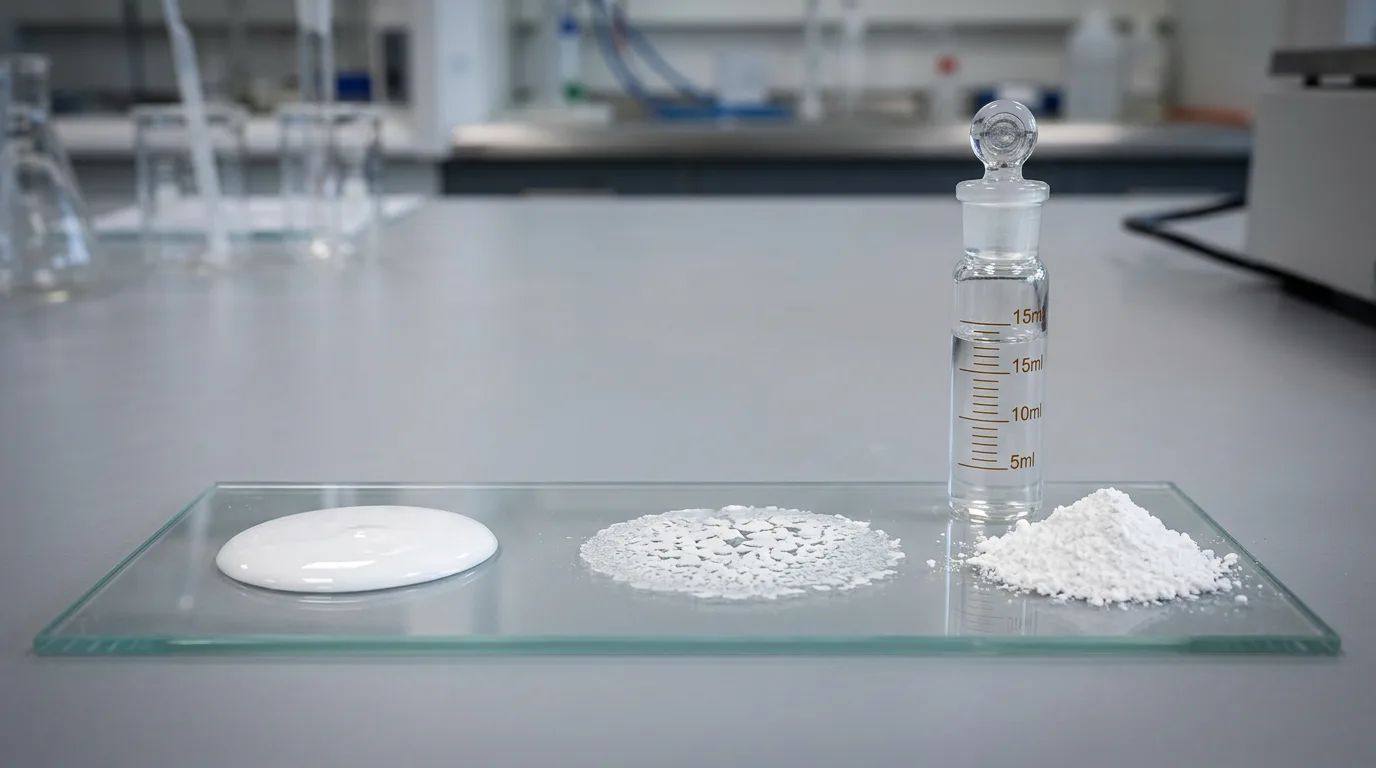
Most athletes treat liquid chalk as a black box — squeeze, rub, grip. But the engineering inside that bottle determines everything about your experience: how fast it dries, how long the grip holds, and whether the formula works with your specific sweat profile. Here's what's actually happening at each stage.
Stage 1: The Suspension
Inside the bottle, magnesium carbonate particles are suspended in an alcohol solution. "Suspended" is the operative word — the particles don't dissolve in alcohol the way sugar dissolves in water. They float in it, held in place by the liquid's viscosity and, in better formulations, by suspension agents that prevent settling.
Magnesium carbonate (MgCO3) is an inorganic salt with a white, powdery appearance in its pure form. The particles used in liquid chalk are ground to a specific fineness — typically 5–50 micrometers in diameter. Finer particles create smoother coatings and stay suspended longer. Coarser particles settle faster but can provide a grittier texture that some athletes prefer for bar grip.
The alcohol carrier is typically isopropyl alcohol (IPA) at 60–70% concentration or ethanol at similar ratios. The alcohol-to-chalk ratio determines the formula's consistency: more alcohol means a thinner, faster-drying liquid; less alcohol means a thicker paste with higher chalk density per drop.
Stage 2: Application and Spreading
When you squeeze liquid chalk onto your palm and rub your hands together, two things happen simultaneously. The mechanical action of rubbing spreads the suspension across your skin surfaces, and the heat from your hands begins accelerating alcohol evaporation.
Human palm temperature averages 32–35°C (90–95°F). Isopropyl alcohol's boiling point is 82.6°C, but it begins evaporating well below that — the rate increases with temperature. Your body heat provides enough thermal energy to evaporate a thin film of IPA within 10–30 seconds, depending on the layer thickness.
During spreading, the magnesium carbonate particles settle into the natural texture of your skin. Your palms aren't smooth — they have ridges (fingerprints), valleys (creases), and pores that create a topography at the microscopic level. The chalk particles mechanically interlock with this texture, which is why liquid chalk stays on your skin more tenaciously than powder chalk that simply sits on the surface.
Stage 3: Alcohol Evaporation and Bonding
This is the phase that turns a wet liquid into a dry grip surface. As the alcohol evaporates from the outer surface inward, the magnesium carbonate particles are left behind in progressively higher concentration until only the chalk layer remains.
The evaporation process creates the bonding mechanism that makes liquid chalk superior to powder for many applications. As the alcohol evaporates through the layer of chalk particles, it creates a compressive force that pushes the particles against your skin and against each other. This is similar to how wet sand holds its shape better than dry sand — the liquid creates cohesion between particles. But unlike water (which doesn't evaporate quickly from skin), alcohol removes itself cleanly, leaving only the compressed chalk structure behind.
The resulting chalk layer is 50–100 micrometers thick — roughly the width of a human hair. It's thin enough to be barely visible but substantial enough to absorb moisture and create measurable friction improvement.
Stage 4: Moisture Absorption (The Grip Phase)
Once the alcohol is gone and the chalk layer is bonded to your skin, the real work begins. Magnesium carbonate is hygroscopic — it naturally attracts and absorbs water molecules from its surrounding environment. This is the property that makes chalk useful for athletes.
Your eccrine sweat glands produce a dilute salt solution (about 99% water, 1% salts and proteins) at rates of 0.5–2.0 liters per hour during intense exercise. Without chalk, this sweat film creates a lubricating layer between your skin and the gripping surface — reducing friction and causing slipping.
The magnesium carbonate layer absorbs this sweat as it reaches the skin surface. The MgCO3 particles trap water molecules within their crystalline structure, effectively removing the lubricating film. The result is a dry interface between your chalked skin and the equipment surface, maintaining high friction even as your body continues to produce sweat.
This absorption has a capacity limit. Each particle of magnesium carbonate can only absorb so much moisture before it becomes saturated. Once the chalk layer is saturated, sweat begins breaking through the surface — this is when you notice your grip starting to fail. The total absorption capacity depends on the chalk layer thickness, the particle size, and the density of the coating. Thicker coatings and higher-density formulas absorb more sweat before saturation.
What Advanced Additives Actually Do
Beyond the base magnesium-carbonate-and-alcohol formula, modern liquid chalks include compounds that modify or extend the grip mechanism.
Rosin (Colophony)
Rosin is a solid form of pine tree resin. When dissolved in alcohol and mixed with magnesium carbonate, it co-deposits on the skin along with the chalk particles. Rosin is naturally tacky at room temperature — it increases friction not by absorbing moisture (like MgCO3) but by creating adhesive contact between the chalk surface and the gripping surface.
Think of it as adding a layer of mild glue on top of the drying agent. The magnesium carbonate handles sweat absorption while the rosin handles surface adhesion. Combined, they provide both a dry palm and a sticky grip — which is why rosin-enhanced products (like Liquid Grip and Spider Chalk White Widow) tend to outperform pure MgCO3 formulas on smooth, polished bar surfaces.
The downside: rosin is harder to wash off, can irritate skin with repeated use, and may trigger reactions in people with tree-sap sensitivities.
Nano-Resin Technology
Spider Chalk's proprietary Grip-Lock Technology represents the engineering frontier of liquid chalk. Nano-resins are synthetic compounds designed at the molecular scale to bond with both the magnesium carbonate layer and the protein structures on skin surfaces. The result is a grip layer that resists both mechanical abrasion (friction from gripping) and chemical degradation (dissolution by sweat).
In practical terms, nano-resin formulas extend grip duration from the typical 20–35 minutes of standard chalk to 45–60 minutes under moderate sweating conditions. The nano-resin particles fill the gaps between larger MgCO3 particles, creating a denser barrier that sweat must work harder to penetrate.
Honey
Honey is a natural hydrocolloid — it creates a viscous layer when activated by moisture. In PowerGrip's formula, honey is co-deposited with the magnesium carbonate during the drying phase. Initially, the MgCO3 does the primary grip work. But as the chalk layer degrades from sweat and friction, the exposed honey compound activates — creating a secondary tacky layer that extends usable grip time by 10–15 minutes.
It's a clever two-stage approach: chalk first, then honey as a backup. The result is grip that degrades gracefully rather than failing suddenly.
Silica Silylate (The Alternative Path)
Chalkless products use silica silylate instead of magnesium carbonate. This compound works through an entirely different mechanism: instead of absorbing moisture, silica silylate creates a hydrophobic (water-repelling) barrier on the skin surface. Sweat beads up and rolls off rather than forming a lubricating film.
The friction comes from the silica's surface texture, not from drying the skin. The practical result is an invisible grip layer with zero chalk residue. The science is solid — silica silylate is used in industrial anti-slip coatings and pharmaceutical formulations — but the feel is noticeably different from traditional chalk, and the per-application cost is substantially higher.
Why Grip Fails (and What You Can Do)
Understanding the failure mechanism helps you manage grip in real time.
Sweat saturation: The chalk layer's absorption capacity is finite. Heavy sweaters exhaust it faster. Solution: reapply more frequently, or use a thicker-consistency formula that deposits more chalk per application.
Mechanical wear: Every time you grip and release, some chalk transfers to the equipment surface. Repetitive gripping (like 50 pull-ups in a CrossFit WOD) wears through the layer faster than static holds. Solution: reapply at natural break points in your workout.
Humidity: In humid environments, the chalk layer must absorb moisture from the air in addition to your sweat. This accelerates saturation. Solution: use rosin-enhanced or nano-resin products that fight moisture through adhesion rather than absorption alone.
Incomplete drying: If you grip the bar before the alcohol fully evaporates, the chalk hasn't bonded properly. The partially-formed layer wipes off on first contact. Solution: wait the full stated dry time. If you feel any dampness or coolness on your palms, you're not ready.
The Physics of Friction
At its core, liquid chalk improves grip by increasing the coefficient of static friction between your skin and a gripping surface. Friction is governed by two factors: the normal force (how hard you squeeze) and the surface conditions (how much the surfaces resist sliding).
Sweat reduces the coefficient of friction by introducing a thin liquid film between surfaces — the same reason wet roads are slippery. Chalk removes that film. Studies on rock climbing grip have measured friction coefficients of roughly 0.4–0.6 for dry, unchalked skin on sandstone, increasing to 0.7–1.0+ with chalk application. On steel surfaces (barbells), the effect is proportionally similar.
This isn't a trivial improvement. For a 200-pound deadlift where grip is the limiting factor, a 40% increase in friction coefficient can be the difference between the bar staying in your hands and it rolling out of your fingers at lockout. The heavier the load, the more grip friction matters — which is why chalk use increases with training advancement. Beginners rarely need chalk for their working weights; advanced lifters need it for almost every heavy set.
Understanding the Science: Questions
Why does liquid chalk absorb sweat?
Magnesium carbonate is hygroscopic — its crystalline structure has a natural affinity for water molecules. When sweat reaches the chalk layer on your skin, the MgCO3 particles absorb the moisture and trap it within their structure, keeping the surface dry and friction-ready.
Does alcohol in liquid chalk sanitize your hands?
Partially. The isopropyl alcohol concentration in most liquid chalks (typically 40–60%) does kill many surface bacteria during the 10–30 seconds it takes to evaporate. It's not a medical-grade sanitizer, but it provides a baseline antimicrobial effect with every application.
Why does liquid chalk grip better than bare hands?
Bare skin produces sweat and oils that create a thin lubricating layer between your hand and the gripping surface. Magnesium carbonate absorbs that moisture and creates a dry, high-friction interface. The friction coefficient of chalked skin on steel or textured surfaces is measurably higher than unchalked skin under sweating conditions.
Can liquid chalk work in humid environments?
Yes, but grip duration is shorter. Humidity adds airborne moisture that the chalk layer must absorb in addition to your sweat. In humid conditions (above 70% relative humidity), expect grip times to decrease by 20–30%. Rosin-enhanced and nano-resin formulas handle humidity better than basic magnesium carbonate products.
What happens to the chalk after it wears off?
The magnesium carbonate gradually transfers from your skin to the gripping surface (barbell, climbing hold, etc.) through friction. It also gets absorbed by sweat and breaks down mechanically during repeated gripping motions. The residue washes off easily with soap and water.
Get Grip Tips Delivered
One email per week. Honest reviews, no spam.
Only when something changes. Unsubscribe anytime.