Does Liquid Chalk Expire? Shelf Life, Storage & Revival
Liquid chalk does not expire in the way food does — it will not become toxic or dangerous after a certain date. But it does degrade. The alcohol carrier evaporates over time, the magnesium carbonate separates from the suspension, and the formula gradually loses its ability to deliver a consistent, effective grip layer. Understanding this degradation process helps you store your chalk properly and know when a bottle is past saving.
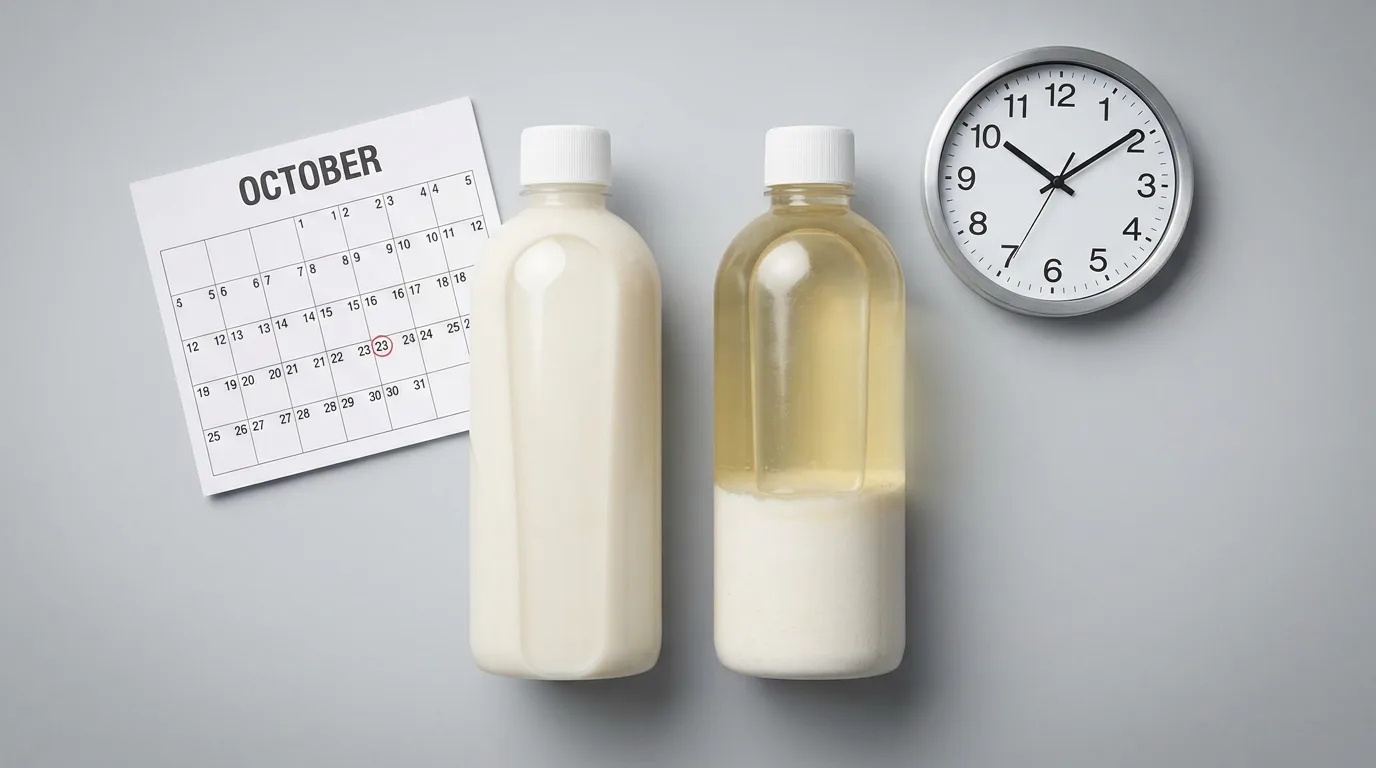
We break down the shelf life by formula type, explain the signs of degradation, and cover the one revival technique that actually works. If you have ever opened a bottle and found a thick paste instead of a spreadable liquid, this guide explains why it happened and whether you can fix it.
Shelf Life by Formula Type
Not all liquid chalk products degrade at the same rate. The formula composition — specifically the alcohol type, the presence of additives, and the bottle seal quality — determines how long a product stays effective.
Basic Formulas (MgCO3 + Alcohol)
Products containing only magnesium carbonate and isopropyl or ethanol alcohol have the longest shelf life: 2-3 years unopened, 12-18 months after opening. The formula is simple, chemically stable, and the alcohol acts as a natural preservative. Products like EVMT Brands, HR8 Chalk, and budget options in this category age predictably — slow alcohol evaporation through the seal is the only degradation mechanism.
Rosin-Enhanced Formulas
Rosin (pine resin) is chemically stable at room temperature, so rosin-enhanced products like Liquid Grip have a similar sealed shelf life to basic formulas: 2-3 years. After opening, the rosin component remains functional even as the alcohol evaporates. The practical effect is that rosin formulas become stickier as they age — the rosin concentration increases relative to the evaporating alcohol. This is not necessarily bad; some athletes prefer the thicker consistency. But the application becomes less smooth and the dry time increases.
Honey-Blend Formulas
Honey is hygroscopic — it absorbs moisture from the air. In a sealed bottle, this is not an issue. After opening, honey-blend products (like PowerGrip) absorb ambient humidity through the cap seal, which can alter the formula's water content over time. Shelf life after opening is shorter: 8-12 months in moderate climates, potentially less in humid environments. The honey itself does not spoil (honey has an essentially indefinite shelf life), but the formula balance shifts as moisture enters.
Nano-Resin / Proprietary Formulas
Spider Chalk's Grip-Lock Technology and other proprietary compounds are engineered for chemical stability. Sealed shelf life is comparable to basic formulas. After opening, the nano-resin particles remain in suspension longer than plain magnesium carbonate because the resin compounds help maintain the suspension matrix. Practical shelf life after opening: 12-18 months, similar to basic formulas.
Granular Products (Chalkless)
Chalkless products use dry silica silylate granules — no liquid carrier at all. Without alcohol to evaporate, the shelf life is functionally unlimited as long as the container remains sealed and dry. Moisture contamination (leaving the tube open in a humid gym bag) is the only degradation concern. Properly stored, Chalkless granules perform identically whether they are 1 month old or 5 years old.
Signs Your Liquid Chalk Has Degraded
You do not need a chemistry lab to determine whether your liquid chalk is still effective. These physical signs tell you everything.
Separation: The first sign of aging. Open the bottle and see a clear liquid layer on top with a thick paste or solid layer on the bottom. In a fresh bottle, the magnesium carbonate is evenly suspended in the alcohol. As the suspension breaks down over time — or after sitting undisturbed for weeks — the denser chalk particles settle to the bottom. This is normal and not a sign of expiration. Shake vigorously for 15-20 seconds to re-suspend the particles. If the formula remixes into a smooth, spreadable consistency, it is still usable.
Thickening: The formula has noticeably thicker consistency than when new. Squeezing the bottle produces a paste rather than a liquid. This happens because alcohol evaporates through the cap seal over months, concentrating the remaining magnesium carbonate. Mild thickening is manageable — the chalk still works, just with a slightly different application feel and longer dry time. Severe thickening (the consistency of toothpaste or drier) means enough alcohol has escaped that the formula can no longer spread thinly enough for effective coverage.
Clumping: Hard chunks or grainy lumps in an otherwise liquid formula. This occurs when magnesium carbonate crystallizes after repeated exposure to air moisture, or when partial evaporation creates localized dry spots inside the bottle. Small clumps can be broken up by shaking. Large, hard clumps that resist shaking indicate the product is significantly degraded.
Weak or absent alcohol smell: Fresh liquid chalk has a distinct alcohol scent during application that fades within 15-30 seconds. If opening the bottle produces little or no alcohol smell, most of the carrier has evaporated. The remaining product has a higher chalk-to-alcohol ratio than intended, resulting in a thick, difficult-to-spread formula with poor skin coverage.
Color change: Standard liquid chalk is white to off-white. A yellowing tint in a basic (non-rosin) formula suggests contamination or chemical change — rare, but a signal to discard the product. Rosin-enhanced products may develop a slightly amber tint naturally, which is normal (rosin is amber-colored).
How to Store Liquid Chalk Properly
Proper storage can double the effective life of an opened bottle. The three enemies of liquid chalk are heat, air exposure, and direct sunlight — all of which accelerate alcohol evaporation.
Temperature: Store at room temperature, 15-25°C (59-77°F). Avoid leaving bottles in hot car trunks, near heaters, or on sunny windowsills. Heat accelerates evaporation through even well-sealed caps. A gym bag stored in a climate-controlled room is fine. A gym bag left in a hot car for 8 hours is not.
Cap seal: Close the cap fully and tightly after every use. This is the single most impactful storage habit. A cap left slightly ajar — even a quarter-turn loose — allows alcohol vapor to escape continuously. Squeeze bottles with flip-top caps are especially prone to this; the flip mechanism does not create an airtight seal. If your bottle has a flip-top, consider closing the main screw cap underneath after each use.
Orientation: Store bottles upright with the cap on top. Inverted storage puts liquid chalk in constant contact with the cap seal, which can weaken the seal over time and create slow leak paths. Upright storage keeps the air gap between the liquid surface and the cap, minimizing evaporation through the seal.
Light exposure: Direct sunlight warms the bottle and can degrade certain additives (rosin, honey) through UV exposure over long periods. Store in a drawer, gym bag, or cabinet — anywhere out of direct sunlight. This is a minor concern compared to temperature and cap seal, but it costs nothing to get right.
How to Revive Thickened Liquid Chalk
If your liquid chalk has thickened from alcohol evaporation but has not fully solidified, you can restore it. This works for formulas that have lost some alcohol but still have enough liquid to remix.
The Revival Process
- Identify the thickening level: Shake the bottle vigorously for 20 seconds. If the contents move and partially remix, revival is possible. If the contents feel solid and immovable, the bottle is too far gone — discard it.
- Add isopropyl alcohol: Buy a bottle of 70% isopropyl alcohol (rubbing alcohol, available at any pharmacy). Open your chalk bottle and add a small amount — start with 1-2 teaspoons for a 50ml bottle, or 1-2 tablespoons for a 250ml bottle.
- Shake thoroughly: Close the cap tightly and shake for 30-60 seconds. The added alcohol re-dissolves the thickened chalk and restores the suspension.
- Check consistency: The formula should now pour and spread like it did when new. If still too thick, add more alcohol in small increments — a teaspoon at a time — until you reach the desired consistency.
- Test on your palm: Apply a small amount and let it dry. The revived formula should dry in 15-25 seconds and leave a smooth, even chalk layer. If it dries noticeably slower or leaves a gritty, uneven coating, the chalk-to-alcohol ratio needs further adjustment.
Use isopropyl alcohol, not water. Water does not evaporate fast enough at body temperature to create the proper chalk-to-skin bond. Adding water creates a wet paste that stays damp on your hands, provides poor friction, and can actually make grip worse than bare skin. Alcohol is the only appropriate thinner because it replicates the original carrier chemistry.
Use isopropyl alcohol, not ethanol (unless the original formula uses ethanol). Most liquid chalks use isopropyl alcohol as the carrier. Adding ethanol to an isopropyl-based formula changes the evaporation rate and may alter the grip feel. Match the alcohol type to the original formula if possible. If you are unsure, isopropyl is the safer default.
How Long Does an Open Bottle Last in Practice?
Shelf life numbers are useful as a guideline, but practical duration depends on how frequently you open the bottle and how you store it between sessions.
Daily training, daily use: A 50ml bottle lasts 2-6 weeks of daily use (30-60 applications). You will use the entire bottle before any degradation occurs. Shelf life is irrelevant at this consumption rate.
3-4 sessions per week: A 50ml bottle lasts 4-10 weeks. Still fast enough that degradation is not a factor. A 250ml bottle at this frequency lasts 4-6 months — within the safe window for all formula types.
Occasional use (1-2 sessions per week): A 50ml bottle lasts 2-4 months. No degradation concern. A 250ml bottle may last 6-12 months. At the longer end of this range, you may notice mild thickening — shake vigorously before each use and the formula works normally.
Seasonal or infrequent use: If you only use liquid chalk for competition prep, outdoor climbing season, or specific training phases, a bottle can sit unused for months. This is where storage matters most. Follow the storage guidelines above, and check the bottle before each use by shaking and testing consistency. Most formulas remain effective for 12-18 months even with infrequent use, as long as the cap stays sealed.
Does Buying in Bulk Make Sense?
Buying a 250ml bottle instead of a 50ml bottle saves money per application. But if the larger bottle degrades before you finish it, the savings disappear.
The math is simple: estimate your monthly consumption (number of sessions per week times roughly 0.5-1ml per application). Divide your bottle size by that number. If the result is under 12 months, bulk is a smart buy. If the result is over 18 months, you are better off buying smaller bottles more frequently — the product will stay fresher, and you avoid the risk of a half-used bottle turning to paste.
Athletes who train 4+ days per week benefit from 250ml bottles. The consumption rate outpaces any degradation. Athletes who train 1-2 days per week, or who use chalk seasonally, are better served by 50ml or 60ml bottles that get used up within their freshness window.
Product-Specific Shelf Life Notes
Based on our research of all 19 products in our catalog, here are the formula types and their practical shelf life characteristics.
Long shelf life (18+ months after opening): Pure MgCO3 + alcohol formulas — EVMT Brands, HR8 Chalk, WARM BODY COLD MIND, OUTTDOZ, Medi Chalk, EAGLES, Catalyst Athletics. Simple formulas with nothing to degrade beyond the alcohol carrier.
Standard shelf life (12-18 months after opening): Rosin-enhanced and nano-resin formulas — Spider Chalk White Widow, Spider Chalk Black Widow, Liquid Grip, SpartaFlex. The additives are chemically stable; shelf life matches basic formulas.
Shorter shelf life (8-12 months after opening): Honey-blend and multi-additive formulas — PowerGrip, SURVIVOR. The hygroscopic honey component absorbs ambient moisture, gradually shifting the formula balance. These products benefit most from the two-bottle decanting system and cool, dry storage.
Functionally unlimited: Chalkless BLACK and Chalkless CLEAR. Dry granules with no liquid carrier. Store them dry and they last indefinitely.
Liquid Chalk Shelf Life FAQ
How long does liquid chalk last unopened?
Most liquid chalk products last 2-3 years unopened when stored at room temperature away from direct sunlight. The alcohol carrier acts as a preservative, preventing bacterial growth and keeping the magnesium carbonate in suspension. Check the manufacturer's packaging for a specific expiration date or batch code if available.
Can expired liquid chalk make you sick?
No. Magnesium carbonate is a stable, inert mineral compound that does not decompose into harmful substances. Expired liquid chalk simply becomes less effective — the alcohol evaporates and the chalk thickens or separates. Applying a degraded formula to your skin poses no health risk; it just won't grip as well.
Why did my liquid chalk turn into a solid block?
The alcohol carrier evaporated through the cap seal. Without the liquid component, the magnesium carbonate dries into a solid mass. This usually happens when a bottle is stored for months with a loose or damaged cap, or in a warm environment that accelerates evaporation. A fully solidified bottle cannot be revived — the chalk-to-alcohol ratio is unrecoverable.
Can I add water to thickened liquid chalk?
No. Water does not behave like the alcohol carrier. Adding water creates a paste that never dries properly on your hands, leaving a damp, crumbly coating with poor grip. If your chalk has thickened, add isopropyl alcohol (rubbing alcohol, 70% concentration) instead — it restores the original consistency and evaporation behavior.
Does temperature affect liquid chalk shelf life?
Yes. Heat accelerates alcohol evaporation through the bottle seal, thickening the formula over time. Leaving liquid chalk in a hot car trunk or near a heater shortens its useful life by months. Cold temperatures slow evaporation but can cause temporary thickening — the chalk returns to normal consistency at room temperature.
Should I refrigerate liquid chalk?
It is not necessary for most products. Room temperature (15-25°C / 59-77°F) is ideal. Refrigeration slows alcohol evaporation marginally but can cause the formula to thicken temporarily, requiring extra shaking before use. The exception: if you live in a very hot climate (consistently above 30°C / 86°F indoors), cool storage extends shelf life noticeably.
Get Grip Tips Delivered
One email per week. Honest reviews, no spam.
Only when something changes. Unsubscribe anytime.